
総合開館30周年記念スペシャル
総合開館30周年記念 トークセッション 写真・映像とこれからの30年
「遠い窓へ 日本の新進作家vol.22」展 関連事業
出品作家とゲストによるトーク
日時:
2025年10月19日(日)14:00-15:30
登壇者:
スクリプカリウ落合安奈(出品作家)
岡ともみ(出品作家)
竹内万里子(批評家・作家、京都芸術大学教授)
大﨑千野(東京都写真美術館学芸員、モデレーター)
開会の挨拶
大﨑千野(以下大﨑):本日は「遠い窓へ 日本の新進作家 vol.22」の関連イベントにお越しくださり、ありがとうございます。本日は出品作家のお二人、スクリプカリウ落合安奈さんと岡ともみさん、そしてゲストに批評家の竹内万里子さんをお迎えしています。まずは、作家のお二人に作品プレゼンテーションをお願いしたいと思います。
スクリプカリウ落合安奈 作品プレゼンテーション
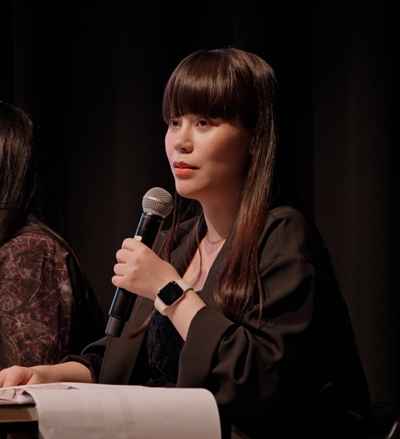
スクリプカリウ落合安奈(以下落合):皆様こんにちは。ご紹介いただきました作家のスクリプカリウ落合安奈です。
私は1992年、日本とルーマニアの両親のもとに生まれました。ルーマニア人の父は幼い頃から身近にはおらず、その不在が「もう一つの文化を探す種」として心に残っており、自分の手でルーマニアの土地や言葉に触れ、文化を「獲得し直す」という試みへと繋がっていきました。
今回の展示では、制作年の異なる二つの《ひ か り の う つ わ》を発表しています。入口では新作の額装作品が象徴的に配置され、奥には五台のスライドプロジェクターを用いたインスタレーションがあります。150枚ほどの35mmフィルムを6分40秒で投影し、写真と詩が互いに呼応するように空間を巡ります。写真が5秒ごとに切り替わり、シャッター音も作品の時間軸をつくる重要な要素です。
作品の背景には、パンデミック下の混乱が残る2022年12月、日本から念願の「もう一つの母国」ルーマニアへの長い旅が始まった経緯に基づいています。 この旅では、この土地で生きていく術を与えてくれた、たくさんの「親のような人々」との出会いがあり、彼らは情報ではなく、感覚を使って世界に直に触れるシンプルな生き方をしていました。
《ひ か り の う つ わ》は、二つの文化の狭間で、人間の営みがどのように引き継がれていくのか、そして危険が伴っても「つないでいきたい」と願うのはなぜか——その問いと共に歩いた一年を形にした作品です。
導入の詩は全体の核心を凝縮したものです。
ひ か り の う つ わ
わたしの旅のはじまりは
あなたの旅のはじまり
もしもわたしに子供が生まれたら
そしてその子供にまた子供が生まれたら
きっと何度も語り継ぐことになるであろう
わたしのもう一つの母国で過ごす
初めての
そしてもしかしたら最後の
かけがえのない季節の一巡りの旅路
……………………
何も知らない
彼方にあるもう一つの母国
わたしの中で肥大化した
透明な臓器に
温かい血を通わせ
色を与えたのは
産みの母でもなく
血縁上の父でもなく
この旅路で出会った
たくさんの「母たち、父たち」だった
日本で自身のルーツに関して質問を受けてもルーマニアについて簡単なことしか知らなかったので、それ以上のことが答えられず、次第に他者から求められるルーマニア人の部分が体の中で「透明な臓器」のように肥大化して苦しくなっていきました。
その臓器に血を通わせて色をつけたいという欲求から、「季節のひと巡り」をルーマニアで過ごしたいと考え、伝統行事をフィルムで撮影しました。
フィルムは不便で繊細ですが、この一度きりの季節を捉えるには最もふさわしい媒体でした。フィルムには空気や光の物質性が宿り、作品を見た人をその場へ連れていく力があります。
この1年間の旅で得られた、一番貴重なものは、たくさんの親のような父たち、母たちと言えるような人々との出会いです。
ルーマニアの伝統的な共同体の踊り「ホラ」は、老若男女が手と手を結び輪になって踊るもので、人が入っていくことでメビウスの輪のように永遠に続いていくような不思議な踊りです。
この踊りの輪や、季節、歴史の巡り、命を含む「旋回の軌跡」は、本作で回転式のアナログの古いスライドプロジェクターを用いていることにも強く結びついています。
帰国から時間が経ち、ようやく手に入れたものが指の間から砂のようにこぼれ落ちていく感覚がある中で、フィルム写真を見るといつでも自分自身をその時に飛ばせることができるのは、写真というメディアを選んだ幸運な点です。
岡ともみ 作品プレゼンテーション
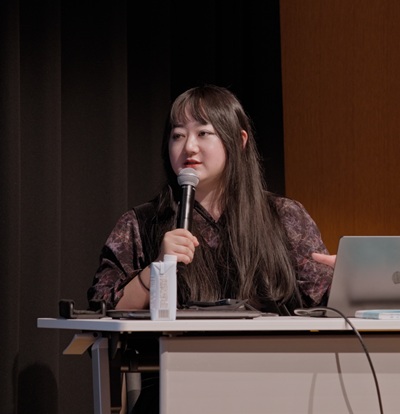
岡ともみ(以下岡):ご紹介に預かりました、岡ともみと申します。
今回は制作を始めた頃から、今作に至るまで、どのような変遷をたどってきたかということをご紹介する構成になっております。
私の初期の作品は舞台作品でした。プロジェクターから映像を投影し、舞台美術に含まれる映像部分などを担当し、初期の4、5年を過ごしました。その後、藝大の学部卒業制作を機に、個人のインスタレーション作品へと軸足を移してきました。
私の関心は、手法としては、映像と空間構成による視覚効果、複数メディアの協調による没入感の創出です。コンセプト的には、「古い道具が持っている物語」や、普通には記録されない「小さな歴史」に興味を持ち、近年は「忘れ去られようとしている民族風習」へと興味を広げてきました。
現代美術に移り、古道具を物語の「語部(かたりべ)」にするということを考えて、最初に取り組んだのが、学部卒業制作の《岡山市柳町 1-8-19》です。テーマは「祖母と祖母の家にまつわる記憶」です。中学時代に亡くなった祖母の家から、手記や、生け花の先生をしていた祖母の花瓶や花器が大量に出てきました。
私は、自分が知っている祖母と、一人の人間としての祖母の人生との間に「乖離のようなもの」が発生したのを感じ、その曖昧さを表現したいと思い作品を制作しました。
最終構成は、祖母の家から持ってきた家具や花瓶を部屋のように配置し、映像を投影しています。さらに奥にはアクリル板がレイヤー状に吊られており、映り込みによって実際の実像と実感している虚像の部分と曖昧で掴めない部分を空間上に展開しました。
この作品は7分ほどのインスタレーションなのですが、吊られた花瓶に光があたり、写真からとった祖母が実際に活けた花が影となって投影される演出がされていました。
本展での作品に移ります。今回の作品は〈サカサゴト〉というタイトルのインスタレーションです。空間には12台の古い掛け時計が天吊りされた柱に配置され、針は逆回転し、盤面も反転しています。振り子が入っている部分には、日本の古い葬送をテーマにリサーチし再解釈した12種類の抽象的な映像が入っています。
「逆さごと」とは、日本各地に残っている、亡くなった方が出た時に、日常の動作を逆の手順で行う風習の総称で、着物の右前と左前を変える、逆さ屏風などが身近な例です。この展示では、時計自身が逆さごとのように振る舞っている作品になります。
批評的視座と展示経験
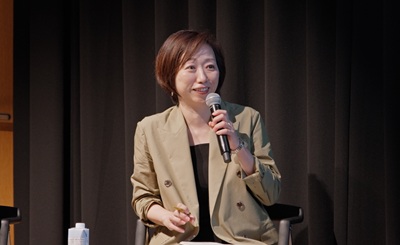
竹内万里子(以下竹内):今回の展覧会タイトル「遠い窓へ」は、ふわりとした言葉でありながら、多様な解釈に開かれた魅力があります。
展示を拝見し、「喪失」というキーワードを強く想起しました。触れようとすると遠ざかるもの、決して触れられないものを抱えながら生きる私たちの在り方。それが「遠い」という言葉に重なりました。
五名の作家はいずれも、喪失や境界という根源的なテーマに向き合い、写真の枠にとらわれない大胆な表現に挑んでいます。非常に密度の高い展示であり、若い作家たちがこれほど自由に写真という媒体を越境している様子に深い感慨を覚えました。
落合さんは、自身のルーツとの向き合いを起点にしながら、多くの人へ開かれる物語として作品を成立させています。個から普遍へと広がる構図が印象的でした。
岡さんは、古道具や風習のリサーチを通して、匿名性を帯びた“誰かの記憶”へと遡り、個人の物語から共同体の記憶へと向かっています。 二人は対照的なベクトルを持ちながら、どちらも「記憶の継承」という点で深く響き合っています。
作家対談:テーマと手法の深層
竹内:プレゼンや図録を見ていただいてもお分かりの通り、若いとは言っても、非常に聡明で、研究も制作も熱心に行い、すでにさまざまな場所で発表もされておられます。とはいえ、美術館というある程度大きな場所での展示に臨まれるにあたって、あるいは実際に経験してみての感想をいただけますでしょうか。
落合:世界各国のキュレーターの方や、これまで私の作品に出会ったことのなかった日本の方など、多くの方に作品が届いているという実感があり、作家冥利に尽きると感じています。
写真美術館の新進作家展は、ずっといつか展示したいという夢の舞台だったので光栄でした。スライドプロジェクターという古い機材を使っているため、長期間の展示にはプレッシャーもありましたが、今回は、新しいチャレンジとして、これまでの2倍ほどの大きなスクリーンで投影しています。
岡:私も、何回も通ってきた美術館でしたので、驚きと嬉しさでスタートしました。今回の作品〈サカサゴト〉は、これまでのコンペなどを経て、写真美術館にたどり着けたというところで、「努力が実った」じゃないですけど作品と一緒に来れたなとうれしく受け止めています。
たくさんの方が来場していただけるパブリックな場で、安全性の担保や見やすさも含めて、作品の要素を損なわずに成立させるのかというところは、すごく勉強させてもらいながら取り組んできました。
竹内:落合さんのインスタレーションで、写真が5秒ごとに切り替わるのはすごく新鮮でした。なぜこの5秒という設定なのか、意図を教えていただけますか。
落合:秒数については、すごい研究をしてギリギリを攻めているところがあります。一番大きいのは、鑑賞者に旋回するさまざまなものに身を委ねて何周もしてほしいという願いです。一回で全て掴めてしまうと、鑑賞者の記憶や経験と結びついて新しい物語が始まるということが起こらないと考えました。また、この5秒という設定は、ルーマニアでの切迫した体感の再現にも繋がっています。
スライドプロジェクターの音は「一日が一回きりしか生きられない」時間の刻みであり、私たち一人一人の心音やリズムにも重なるものです。
竹内:メインビジュアルの「ルーマニアのごはん」について、お話しいただけますか。
落合:これはパスタの一種で、旅の最初、日本に住んでいるルーマニア人の知り合いから紹介された90歳のおじいさんの家にいた、いるはずのないおばあさんが用意してくれた食事です。お互いに言葉も文化も違う中で、食事とテーブルを囲むことで通じ合える、共通するところはご飯だと、心を揺さぶられた一瞬でシャッターを切りました。
竹内:この作品は、個人的な出発点を持っていながら、普遍的なメッセージにつながっています。落合さんの様々な活動の中でどんな位置を占めているのでしょうか。
落合:これは、自分の作家として、そして人生としての「第2章の始まりの作品」だと考えています。第1章の節目となったのは、2021年に発表した、母との対話形式の作品《私の旅のはじまりは、あなたの旅のはじまり》です。
どちらもこれだけ、真正面から自分自身のルーツをモチーフにして、それが「私のものではなく、多くの人に開かれていくものとして確立」できるようになって生まれた作品だという点で重要です。
作家活動の初期には、ルーツを扱っても他者と共有できず、セルフィッシュなものになる怖さをずっと抱えていましたが、10年ほどかけて、多くの人に届くビジュアルランゲージを掴めるようになりました。自分のアイデンティティやルーツに直接向き合い、「ようやく生まれた2つの作品」だと感じています。
竹内:岡さんの作品は、日本の風習という普遍的なリサーチを元に、匿名の個々人に向かっていくという、対照的なベクトルがあるように見えます。ご自分から出発せずに、様々な方法を組み合わせて何ができるか、という関心の方が強いのでしょうか。
岡:そこのバランスは非常に動いています。初期の舞台作品は、視覚的効果に関心が強かったのですが、祖母の家の作品は個人的な話から入っていったものであり、作ろうと思ったきっかけは、祖父の死という非常に個人的な体験が大きく関わっています。
葬儀がスムーズに進む中で、祖父を送る感覚を持てなかったのですが、火葬の際、お花屋さん見つけた青い紫陽花を棺に入れました。そして火葬後、白いはずのお骨がすごくきれいに薄い青に染まって、それを見た時に、やっと祖父の死に対して送る儀式やプロセスを持てたという経験から作品が出発しています。
時計の中に、この青い紫陽花の映像が映っている一台があり、特別な時計として扱っています。
竹内:岡さんのインスタレーションでは、柱も床から少し浮いたような空間も逆さまなイメージを作り出していました。どのような意図があったのでしょうか。
岡:柱を天吊りしたいという意思は展示の当初からありました。それは、柱自身も「もともとあの時計たちが生きていた空間から、柱ごとこちらに来た」というような感覚を表現したかったからです。
竹内:あの空間は、まさに「亡霊みたいに見える」、この世ならぬものに触れているような感覚があり、「私たち鑑賞者が亡霊だろうか」とクラクラするような体験を伴いました。音と言葉の構成についても教えてください。
岡:実は、最初期(修了制作時)の見せ方では、空間に黒いアクリル板を入れていました。これは、盤面が反転しているので、こっち側に映った時に、向こうの世界が「正転」しているという見せ方にしていました。これは、時計が逆さごと状態になっているので、鑑賞する私たちもあちらの世界に行ってしまっているのかも、という気づきを促すためです。
音に関しては、12台の時計の中に音が入っていますが、あえてどの時計から出ているのか分からないようにしています。これは、鑑賞者に「一つ一つの時計を自分で見つけて」「彷徨って」「明かりを頼りに見つけていく」という体験を作りたかったからです。12台の時計が全体として「共鳴している」ような形を狙いました。
結びのメッセージ
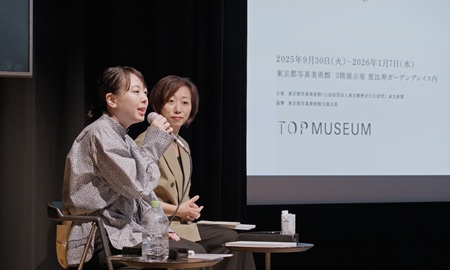
大崎:お二人の作品は、作家自身の内側から生まれたものが、観る人の心へと届くかたちで展示されています。作品を通して「遠くにある誰かの暮らし」や「見えないものへのまなざし」を感じ取っていただければ嬉しく思います。本日はありがとうございました。
※本ページではイベント内容の一部を抜粋してご紹介しています。
トークの全編は下記の動画にてご覧いただけます。
TOP 30th Anniversary Talk Session
“Thoughts of a Distant Window: Contemporary Japanese Photography vol. 22” Conversation between the exhibiting artists and guests
Date:
Octover 19, 2025, 14:00-15:30
Speakers:
Scripcariu-Ochiai Ana (Exhibiting Artist)
Oka Tomomi (Exhibiting Artist)
Takeuchi Mariko(Critic, Author, Professor at Kyoto University of the Arts)
Osaki Chino (Curator of Tokyo Photographic Art Museum, Moderator)
Opening Remarks
Osaki Chino (OC): Thank you for joining this event organized in conjunction with the exhibition “Thoughts of a Distant Window: Contemporary Japanese Photography vol. 22.” We have invited two of the exhibiting artists, Scripcariu-Ochiai Ana and Oka Tomomi, as well as the guest speaker, art critic Takeuchi Mariko. Before anything, I would like to ask the artists to give a presentation of their works.
Scripcariu-Ochiai Ana Presentation
Scripcariu-Ochiai Ana (SA): Hello everyone, my name is Scripcariu-Ochiai Ana. I am an artist.
I was born in 1992 to Japanese and Romanian parents. My Romanian father was not around since my childhood. This absence has stayed in my heart as “the seed to look for the other culture,” leading to my investigation of the Romanian land and language to “regain” a culture with my own hands.
For this exhibition, I have presented two versions of the work “Vessels of Light,” produced in different years. The newest framed piece was symbolically installed at the entrance, and an installation followed in the room with 5 slide projectors. About 150 slides of 35mm film were projected over 6 minutes and 40 seconds, allowing images and poetry to circulate through the space where photographs and poetry resonate with each other. The images switch every 5 seconds, and the sound of this shutter is another important factor that shapes the timeline of the work.
This series is based on the sequence of events that prompted my long journey from Japan to Romania in December 2022, with still traces of the tumultuous pandemic. It was a visit to “the other homeland” I had yearned for.
In this journey, I encountered many people who seemed to me like another parent, teaching me tips of life on this land. They were living not off of information but a simple lifestyle of touching the world with their senses.
“Vessels of Light” is a body of work shaped by the one year I spent with the question, how are the lives of people passed down between two cultures, and why people wish to keep the connection between two cultures, regardless of the risks it may involve?
The introductory poetry is the condensed heart of the whole.
Vessels of Light
The beginning of my journey
Is the beginning of yours
To my unborn children
And their children
This is a story I will tell, over and over again
A journey through a season that will never come again
In my other motherland
For the first time
And perhaps the last
...............
It was the unknown
A faraway motherland
My bloated, transparent organs
Became filled with the warmth of blood
And with color
Not by my birth mother
Or my blood father
But the countless “mothers” and “fathers”
I met along the journey
In Japan, I was unable to answer much when asked where I came from because I knew so little about Romania. Gradually, the Romanian aspects expected of me began to swell inside my body, like a “transparent organ,” suffocating me.
With a desire for the blood to flow and add color to that organ, I began to photograph traditional events with film, wanting to spend “a full cycle of the seasons” in Romania.
Films are inconvenient and delicate, but no other medium is more suited to capturing the once-in-a-lifetime seasons. The materiality of the air and light dwells in the film, exerting a certain power that takes its viewers to the places depicted in the images.
The most precious thing I earned from this one-year journey was the encounter with people—those I can call fathers and mothers, as if I had a lot of parents.
The Romanian traditional community dance called “hora” is one where people of all ages and genders dance in a circle, hand in hand. It was an extraordinary dance that seemed to last forever, like a Möbius loop, as people joined the circle.
The circle of this dance, the seasons, the course of history, and the “turning path,” including the life of a being, are strongly tied to the use of an old analog rotating projector.
The fortunate merit of having chosen photography as the medium was to be able to take myself back to the time captured whenever looking at the film, even a while after my return to Japan, when the sensation that things I had finally laid my hands on start to fall from between my fingers.
Oka Tomomi Presentation
Oka Tomomi (OT): Hi, my name is Oka Tomomi.
Today, I will be presenting the course of transitions from when I began practicing art to the realization of this body of work.
My earlier works were for theater pieces. I had spent the first four to five years working on moving images included in stage design, screened with a projector. Later on, I shifted to creating personal installation works after my Bachelor's graduation project at Tokyo University of the Arts.
My interest revolved around the realization of an immersive environment using visual effects composed of moving images and spatial design, as well as the harmony of multiple media. I was drawn to the “stories enclosed in old tools” and the “small history” that usually goes unrecorded. Last year, I expanded my field of study to “folk customs fading away.”
After shifting my practice to contemporary art, the first thing I worked on was “1-8-19, Yanagimachi, Okayama-City” for my Bachelor’s graduation showcase, with the intention of turning old tools into storytellers. The theme was “the memories of my grandmother and of my grandmother’s house.” An ikebana teacher, heaps of flower vases and vessels, with her diaries, had come out of my grandmother’s house who passed away when I was in middle school.
The gap I noticed between the grandmother I knew and her life as an individual urged me to create a body of work that portrays this ambiguity.
The final setup brought in furniture and vases from my grandmother’s house to build a room onto which a moving image was projected. At the back, acrylic panels were hung in layers, to reconstruct an ambiguity inside the space by means of the reflections on the panels; your body as the reality, and the illusive image you witness. This work was an installation of about 7 minutes long. It was arranged so that light hits the hanging vases, rendering a shadow of the ikebana works by my grandmother I had extracted from photographs.
Moving on to the work I am showing in the current exhibition, it is an installation piece titled “Sakasagoto - Inverted Ordinary Life –.” 12 old wall clocks are attached to pillars suspended from the ceilings; the hands of the clocks are turning counterclockwise; the faces of the clocks are inverted. 12 abstract moving images replaced the pendulum, each a reinterpretation of the research I conducted on old funeral rites in Japan.
“Sakasagoto” is the collective term for the custom found across Japan in which one reverses daily actions when someone passes away. Wearing the kimono with the left side in front, instead of the right, or placing the folding screen upside down, are a few common examples. In this exhibition, the work acts as if the clocks themselves are “sakasagoto” on their own.
The perspective of the commentary and the exhibition experience
Takeuchi Mariko (TM): The title of this exhibition, “Thoughts of a Distant Window,” has a certain charm. It is at once a hazy phrase, yet it leaves room for diverse interpretations.
After the visit, the show strongly evoked the keyword “loss.” Something that pulls away when one tries to reach for it, or our way of life encompassing something we can never touch. Such ideas overlapped with the word “distant.”
The five artists each confront a fundamental theme of loss and boundaries, challenging themselves to bold expressions unrestrained by photography as a framework. A very dense exhibition, I was deeply moved by how these young artists are transcending photography as a medium with such freedom.
From her reflection on her own background as the starting point, Ms. Ochiai has established a work that can act as a story for many. The composition that expands from the personal to the universal was impressive.
Through the research of old tools and customs, Ms. Oka traces back to “someone’s memory” shrouded in anonymity, while the personal stories shift to a collective memory.
While both of their works stand on the two ends of a spectrum, they also deeply resonate with each other in terms of “a succession of memory.”
Artist Discussion: the deep layers of themes and methods
TM: They may be young, but as evident from their presentations and the exhibition catalog, they are very bright, working diligently on their research and practice, and having already shown their works on different occasions. Nevertheless, what were your thoughts on preparing for an exhibition at a relatively large venue like a museum, or perhaps your impressions after actually experiencing it?
SA: I feel a deep sense of fulfillment as an artist, knowing my work has reached so many people—curators from around the world and Japanese viewers who had never seen my work before. I was honored because the “Contemporary Japanese Photography” series at the Tokyo Photographic Art Museum was one dream stage I had always aspired to. There was indeed some worry for this long-term exhibition, as I was using old slide projectors. At the same time, I decided to project the images onto a screen twice the size of what I had shown in the past, as a new challenge.
OT: I, too, started it with surprise and delight because it was the museum I had visited countless times. Not just that hard work pays off, but I am happy because I felt like I had reached the Tokyo Photographic Art Museum together with the work exhibited here, “Sakasagoto – Inverted Ordinary Life –,” after experiencing past competitions.
As a public space with a large number of visitors, I built this exhibition, learning how to not hinder the aspects of the work while working in accordance with safety protocols and a better visiting experience.
TM: The photographs changing every 5 seconds in Ms. Ochiai’s installation felt very fresh. Why did you set it up as 5 seconds?
SA: The duration was calculated after thorough research and pushing the limits. The most important part of the decision was my wish for the viewers to let themselves be carried away by the many things that are turning around, and to experience multiple cycles. I thought that if the viewers could grasp everything in one go, the work would link to no memories or experience of the viewer, and no new stories would be born. Furthermore, this 5-second rule also connects to a recreation of the sense of urgency I felt in Romania.
The sound of the slide projector is the ticking of time “in one day that can only live once,” overlapping with each of our own rhythm or heartbeat.
TM: Can you please tell us a little about the photograph of a Romanian meal, used as the main visual?
SA: This is a type of pasta which is a meal that was prepared by an old lady—who was not supposed to be there—at the beginning of my journey, in the house of a 90-year-old man, introduced by one of my Romanian acquaintances living in Japan. Although both of us were living in different cultures with different languages, eating a meal together at a table created a connection; what we had in common was the meal. In that heart-stirring moment, I took the picture.
TM: This work embodies your personal point of origin while leading up to a more universal message. What position does it take within the wide span of your practice?
SA: I consider this work “the beginning of my second chapter” as an artist and of my life. The milestone in the first chapter was the series “The beginning of my journey is the beginning of your journey” that I created in 2021 as a dialogue with my mother.
They are both important in the sense that, despite straightforwardly dealing with my own roots, the works were brought to life after I was able to establish the topic as something that can relate to many others, and not exclusively my own.
When I began my artist career, I was unable to share with others what I had created themed on my background, and I always feared that the work would seem selfish. Over the course of 10 years, I was able to grasp the visual languages that could reach more people. I believe that these are the two works that finally emerged, facing my identity and points of origin.
TM: Ms. Oka’s works, beginning with a universal research—the Japanese customs—heading towards anonymous individuals, seem to stand on the other side of the spectrum. Are you more interested in exploring different combinations of methods instead of using yourself as the starting point?
OT: That balance is always shifting. I was very interested in the visual effects when I was creating my early theater works while the piece on my grandmother’s house began with a personal story, as the loss of my grandfather, a very personal experience, came into play.
As the funeral was proceeding smoothly, I was unable to feel like I was really saying goodbye to my grandfather. At the moment of the cremation, I placed a blue hydrangea I found at a flower shop inside the coffin. After the cremation, the supposedly white bones had come out, tinted with a beautiful pale blue. That was the moment I was able to take in the memorial ceremony and process for my grandfather’s passing. This experience prompted the creation of this work.
Among the clocks, one is playing a moving image of a blue hydrangea. I consider this clock special.
TM: In your installation, the pillars were slightly above ground and gave the impression that the space itself was upside down. What was the intention behind this?
OT: I wanted to suspend the pillar from the beginning of the preparation for this exhibition. I intended to portray the sensation that the pillars themselves were “brought altogether from the space the clocks used to live.”
TM: That space feels like we are touching something otherworldly, as if seeing a ghost. I experienced a sort of dizziness that made me believe “we, the audience, may be the ghosts.” Can you please tell us about the composition of the sound and text?
OT: Actually, in the very first presentation of the work at the time of my graduation project, I had placed a black acrylic panel inside the space. Because the face of the clock is inverted, the reflections on the panel—the world on the other side—were displayed clockwise. I wanted to usher the audience into noticing that they have perhaps stepped over to the other side, given that the clock is “sakasagoto”(reversed).
Sound is playing from all twelve clocks, but I deliberately designed it so you can't tell which clock is making each sound. I wanted to generate an experience where the audience “finds each clock by themselves,” “wanders around,” and “looks for them with the help of the light.” It was a format aiming to show the twelve clocks “resonating” as a whole.
Ending Comment
OC: Both of your works are exhibited, illustrating that what is born inside the artist can be delivered to the hearts of the audience. We hope that the viewers can sense “the faraway lives of someone” or “the gaze towards the unseen” through the show. Thank you very much for joining us today.
「遠い窓へ 日本の新進作家vol.22」展 関連事業
出品作家とゲストによるトーク
日時:
2025年10月19日(日)14:00-15:30
登壇者:
スクリプカリウ落合安奈(出品作家)
岡ともみ(出品作家)
竹内万里子(批評家・作家、京都芸術大学教授)
大﨑千野(東京都写真美術館学芸員、モデレーター)
開会の挨拶
大﨑千野(以下大﨑):本日は「遠い窓へ 日本の新進作家 vol.22」の関連イベントにお越しくださり、ありがとうございます。本日は出品作家のお二人、スクリプカリウ落合安奈さんと岡ともみさん、そしてゲストに批評家の竹内万里子さんをお迎えしています。まずは、作家のお二人に作品プレゼンテーションをお願いしたいと思います。
スクリプカリウ落合安奈 作品プレゼンテーション
スクリプカリウ落合安奈(以下落合):皆様こんにちは。ご紹介いただきました作家のスクリプカリウ落合安奈です。
私は1992年、日本とルーマニアの両親のもとに生まれました。ルーマニア人の父は幼い頃から身近にはおらず、その不在が「もう一つの文化を探す種」として心に残っており、自分の手でルーマニアの土地や言葉に触れ、文化を「獲得し直す」という試みへと繋がっていきました。
今回の展示では、制作年の異なる二つの《ひ か り の う つ わ》を発表しています。入口では新作の額装作品が象徴的に配置され、奥には五台のスライドプロジェクターを用いたインスタレーションがあります。150枚ほどの35mmフィルムを6分40秒で投影し、写真と詩が互いに呼応するように空間を巡ります。写真が5秒ごとに切り替わり、シャッター音も作品の時間軸をつくる重要な要素です。
作品の背景には、パンデミック下の混乱が残る2022年12月、日本から念願の「もう一つの母国」ルーマニアへの長い旅が始まった経緯に基づいています。 この旅では、この土地で生きていく術を与えてくれた、たくさんの「親のような人々」との出会いがあり、彼らは情報ではなく、感覚を使って世界に直に触れるシンプルな生き方をしていました。
《ひ か り の う つ わ》は、二つの文化の狭間で、人間の営みがどのように引き継がれていくのか、そして危険が伴っても「つないでいきたい」と願うのはなぜか——その問いと共に歩いた一年を形にした作品です。
導入の詩は全体の核心を凝縮したものです。
ひ か り の う つ わ
わたしの旅のはじまりは
あなたの旅のはじまり
もしもわたしに子供が生まれたら
そしてその子供にまた子供が生まれたら
きっと何度も語り継ぐことになるであろう
わたしのもう一つの母国で過ごす
初めての
そしてもしかしたら最後の
かけがえのない季節の一巡りの旅路
……………………
何も知らない
彼方にあるもう一つの母国
わたしの中で肥大化した
透明な臓器に
温かい血を通わせ
色を与えたのは
産みの母でもなく
血縁上の父でもなく
この旅路で出会った
たくさんの「母たち、父たち」だった
日本で自身のルーツに関して質問を受けてもルーマニアについて簡単なことしか知らなかったので、それ以上のことが答えられず、次第に他者から求められるルーマニア人の部分が体の中で「透明な臓器」のように肥大化して苦しくなっていきました。
その臓器に血を通わせて色をつけたいという欲求から、「季節のひと巡り」をルーマニアで過ごしたいと考え、伝統行事をフィルムで撮影しました。
フィルムは不便で繊細ですが、この一度きりの季節を捉えるには最もふさわしい媒体でした。フィルムには空気や光の物質性が宿り、作品を見た人をその場へ連れていく力があります。
この1年間の旅で得られた、一番貴重なものは、たくさんの親のような父たち、母たちと言えるような人々との出会いです。
ルーマニアの伝統的な共同体の踊り「ホラ」は、老若男女が手と手を結び輪になって踊るもので、人が入っていくことでメビウスの輪のように永遠に続いていくような不思議な踊りです。
この踊りの輪や、季節、歴史の巡り、命を含む「旋回の軌跡」は、本作で回転式のアナログの古いスライドプロジェクターを用いていることにも強く結びついています。
帰国から時間が経ち、ようやく手に入れたものが指の間から砂のようにこぼれ落ちていく感覚がある中で、フィルム写真を見るといつでも自分自身をその時に飛ばせることができるのは、写真というメディアを選んだ幸運な点です。
岡ともみ 作品プレゼンテーション
岡ともみ(以下岡):ご紹介に預かりました、岡ともみと申します。
今回は制作を始めた頃から、今作に至るまで、どのような変遷をたどってきたかということをご紹介する構成になっております。
私の初期の作品は舞台作品でした。プロジェクターから映像を投影し、舞台美術に含まれる映像部分などを担当し、初期の4、5年を過ごしました。その後、藝大の学部卒業制作を機に、個人のインスタレーション作品へと軸足を移してきました。
私の関心は、手法としては、映像と空間構成による視覚効果、複数メディアの協調による没入感の創出です。コンセプト的には、「古い道具が持っている物語」や、普通には記録されない「小さな歴史」に興味を持ち、近年は「忘れ去られようとしている民族風習」へと興味を広げてきました。
現代美術に移り、古道具を物語の「語部(かたりべ)」にするということを考えて、最初に取り組んだのが、学部卒業制作の《岡山市柳町 1-8-19》です。テーマは「祖母と祖母の家にまつわる記憶」です。中学時代に亡くなった祖母の家から、手記や、生け花の先生をしていた祖母の花瓶や花器が大量に出てきました。
私は、自分が知っている祖母と、一人の人間としての祖母の人生との間に「乖離のようなもの」が発生したのを感じ、その曖昧さを表現したいと思い作品を制作しました。
最終構成は、祖母の家から持ってきた家具や花瓶を部屋のように配置し、映像を投影しています。さらに奥にはアクリル板がレイヤー状に吊られており、映り込みによって実際の実像と実感している虚像の部分と曖昧で掴めない部分を空間上に展開しました。
この作品は7分ほどのインスタレーションなのですが、吊られた花瓶に光があたり、写真からとった祖母が実際に活けた花が影となって投影される演出がされていました。
本展での作品に移ります。今回の作品は〈サカサゴト〉というタイトルのインスタレーションです。空間には12台の古い掛け時計が天吊りされた柱に配置され、針は逆回転し、盤面も反転しています。振り子が入っている部分には、日本の古い葬送をテーマにリサーチし再解釈した12種類の抽象的な映像が入っています。
「逆さごと」とは、日本各地に残っている、亡くなった方が出た時に、日常の動作を逆の手順で行う風習の総称で、着物の右前と左前を変える、逆さ屏風などが身近な例です。この展示では、時計自身が逆さごとのように振る舞っている作品になります。
批評的視座と展示経験
竹内万里子(以下竹内):今回の展覧会タイトル「遠い窓へ」は、ふわりとした言葉でありながら、多様な解釈に開かれた魅力があります。
展示を拝見し、「喪失」というキーワードを強く想起しました。触れようとすると遠ざかるもの、決して触れられないものを抱えながら生きる私たちの在り方。それが「遠い」という言葉に重なりました。
五名の作家はいずれも、喪失や境界という根源的なテーマに向き合い、写真の枠にとらわれない大胆な表現に挑んでいます。非常に密度の高い展示であり、若い作家たちがこれほど自由に写真という媒体を越境している様子に深い感慨を覚えました。
落合さんは、自身のルーツとの向き合いを起点にしながら、多くの人へ開かれる物語として作品を成立させています。個から普遍へと広がる構図が印象的でした。
岡さんは、古道具や風習のリサーチを通して、匿名性を帯びた“誰かの記憶”へと遡り、個人の物語から共同体の記憶へと向かっています。 二人は対照的なベクトルを持ちながら、どちらも「記憶の継承」という点で深く響き合っています。
作家対談:テーマと手法の深層
竹内:プレゼンや図録を見ていただいてもお分かりの通り、若いとは言っても、非常に聡明で、研究も制作も熱心に行い、すでにさまざまな場所で発表もされておられます。とはいえ、美術館というある程度大きな場所での展示に臨まれるにあたって、あるいは実際に経験してみての感想をいただけますでしょうか。
落合:世界各国のキュレーターの方や、これまで私の作品に出会ったことのなかった日本の方など、多くの方に作品が届いているという実感があり、作家冥利に尽きると感じています。
写真美術館の新進作家展は、ずっといつか展示したいという夢の舞台だったので光栄でした。スライドプロジェクターという古い機材を使っているため、長期間の展示にはプレッシャーもありましたが、今回は、新しいチャレンジとして、これまでの2倍ほどの大きなスクリーンで投影しています。
岡:私も、何回も通ってきた美術館でしたので、驚きと嬉しさでスタートしました。今回の作品〈サカサゴト〉は、これまでのコンペなどを経て、写真美術館にたどり着けたというところで、「努力が実った」じゃないですけど作品と一緒に来れたなとうれしく受け止めています。
たくさんの方が来場していただけるパブリックな場で、安全性の担保や見やすさも含めて、作品の要素を損なわずに成立させるのかというところは、すごく勉強させてもらいながら取り組んできました。
竹内:落合さんのインスタレーションで、写真が5秒ごとに切り替わるのはすごく新鮮でした。なぜこの5秒という設定なのか、意図を教えていただけますか。
落合:秒数については、すごい研究をしてギリギリを攻めているところがあります。一番大きいのは、鑑賞者に旋回するさまざまなものに身を委ねて何周もしてほしいという願いです。一回で全て掴めてしまうと、鑑賞者の記憶や経験と結びついて新しい物語が始まるということが起こらないと考えました。また、この5秒という設定は、ルーマニアでの切迫した体感の再現にも繋がっています。
スライドプロジェクターの音は「一日が一回きりしか生きられない」時間の刻みであり、私たち一人一人の心音やリズムにも重なるものです。
竹内:メインビジュアルの「ルーマニアのごはん」について、お話しいただけますか。
落合:これはパスタの一種で、旅の最初、日本に住んでいるルーマニア人の知り合いから紹介された90歳のおじいさんの家にいた、いるはずのないおばあさんが用意してくれた食事です。お互いに言葉も文化も違う中で、食事とテーブルを囲むことで通じ合える、共通するところはご飯だと、心を揺さぶられた一瞬でシャッターを切りました。
竹内:この作品は、個人的な出発点を持っていながら、普遍的なメッセージにつながっています。落合さんの様々な活動の中でどんな位置を占めているのでしょうか。
落合:これは、自分の作家として、そして人生としての「第2章の始まりの作品」だと考えています。第1章の節目となったのは、2021年に発表した、母との対話形式の作品《私の旅のはじまりは、あなたの旅のはじまり》です。
どちらもこれだけ、真正面から自分自身のルーツをモチーフにして、それが「私のものではなく、多くの人に開かれていくものとして確立」できるようになって生まれた作品だという点で重要です。
作家活動の初期には、ルーツを扱っても他者と共有できず、セルフィッシュなものになる怖さをずっと抱えていましたが、10年ほどかけて、多くの人に届くビジュアルランゲージを掴めるようになりました。自分のアイデンティティやルーツに直接向き合い、「ようやく生まれた2つの作品」だと感じています。
竹内:岡さんの作品は、日本の風習という普遍的なリサーチを元に、匿名の個々人に向かっていくという、対照的なベクトルがあるように見えます。ご自分から出発せずに、様々な方法を組み合わせて何ができるか、という関心の方が強いのでしょうか。
岡:そこのバランスは非常に動いています。初期の舞台作品は、視覚的効果に関心が強かったのですが、祖母の家の作品は個人的な話から入っていったものであり、作ろうと思ったきっかけは、祖父の死という非常に個人的な体験が大きく関わっています。
葬儀がスムーズに進む中で、祖父を送る感覚を持てなかったのですが、火葬の際、お花屋さん見つけた青い紫陽花を棺に入れました。そして火葬後、白いはずのお骨がすごくきれいに薄い青に染まって、それを見た時に、やっと祖父の死に対して送る儀式やプロセスを持てたという経験から作品が出発しています。
時計の中に、この青い紫陽花の映像が映っている一台があり、特別な時計として扱っています。
竹内:岡さんのインスタレーションでは、柱も床から少し浮いたような空間も逆さまなイメージを作り出していました。どのような意図があったのでしょうか。
岡:柱を天吊りしたいという意思は展示の当初からありました。それは、柱自身も「もともとあの時計たちが生きていた空間から、柱ごとこちらに来た」というような感覚を表現したかったからです。
竹内:あの空間は、まさに「亡霊みたいに見える」、この世ならぬものに触れているような感覚があり、「私たち鑑賞者が亡霊だろうか」とクラクラするような体験を伴いました。音と言葉の構成についても教えてください。
岡:実は、最初期(修了制作時)の見せ方では、空間に黒いアクリル板を入れていました。これは、盤面が反転しているので、こっち側に映った時に、向こうの世界が「正転」しているという見せ方にしていました。これは、時計が逆さごと状態になっているので、鑑賞する私たちもあちらの世界に行ってしまっているのかも、という気づきを促すためです。
音に関しては、12台の時計の中に音が入っていますが、あえてどの時計から出ているのか分からないようにしています。これは、鑑賞者に「一つ一つの時計を自分で見つけて」「彷徨って」「明かりを頼りに見つけていく」という体験を作りたかったからです。12台の時計が全体として「共鳴している」ような形を狙いました。
結びのメッセージ
大崎:お二人の作品は、作家自身の内側から生まれたものが、観る人の心へと届くかたちで展示されています。作品を通して「遠くにある誰かの暮らし」や「見えないものへのまなざし」を感じ取っていただければ嬉しく思います。本日はありがとうございました。
※本ページではイベント内容の一部を抜粋してご紹介しています。
トークの全編は下記の動画にてご覧いただけます。
TOP 30th Anniversary Talk Session
“Thoughts of a Distant Window: Contemporary Japanese Photography vol. 22” Conversation between the exhibiting artists and guests
Date:
Octover 19, 2025, 14:00-15:30
Speakers:
Scripcariu-Ochiai Ana (Exhibiting Artist)
Oka Tomomi (Exhibiting Artist)
Takeuchi Mariko(Critic, Author, Professor at Kyoto University of the Arts)
Osaki Chino (Curator of Tokyo Photographic Art Museum, Moderator)
Opening Remarks
Osaki Chino (OC): Thank you for joining this event organized in conjunction with the exhibition “Thoughts of a Distant Window: Contemporary Japanese Photography vol. 22.” We have invited two of the exhibiting artists, Scripcariu-Ochiai Ana and Oka Tomomi, as well as the guest speaker, art critic Takeuchi Mariko. Before anything, I would like to ask the artists to give a presentation of their works.
Scripcariu-Ochiai Ana Presentation
Scripcariu-Ochiai Ana (SA): Hello everyone, my name is Scripcariu-Ochiai Ana. I am an artist.
I was born in 1992 to Japanese and Romanian parents. My Romanian father was not around since my childhood. This absence has stayed in my heart as “the seed to look for the other culture,” leading to my investigation of the Romanian land and language to “regain” a culture with my own hands.
For this exhibition, I have presented two versions of the work “Vessels of Light,” produced in different years. The newest framed piece was symbolically installed at the entrance, and an installation followed in the room with 5 slide projectors. About 150 slides of 35mm film were projected over 6 minutes and 40 seconds, allowing images and poetry to circulate through the space where photographs and poetry resonate with each other. The images switch every 5 seconds, and the sound of this shutter is another important factor that shapes the timeline of the work.
This series is based on the sequence of events that prompted my long journey from Japan to Romania in December 2022, with still traces of the tumultuous pandemic. It was a visit to “the other homeland” I had yearned for.
In this journey, I encountered many people who seemed to me like another parent, teaching me tips of life on this land. They were living not off of information but a simple lifestyle of touching the world with their senses.
“Vessels of Light” is a body of work shaped by the one year I spent with the question, how are the lives of people passed down between two cultures, and why people wish to keep the connection between two cultures, regardless of the risks it may involve?
The introductory poetry is the condensed heart of the whole.
Vessels of Light
The beginning of my journey
Is the beginning of yours
To my unborn children
And their children
This is a story I will tell, over and over again
A journey through a season that will never come again
In my other motherland
For the first time
And perhaps the last
...............
It was the unknown
A faraway motherland
My bloated, transparent organs
Became filled with the warmth of blood
And with color
Not by my birth mother
Or my blood father
But the countless “mothers” and “fathers”
I met along the journey
In Japan, I was unable to answer much when asked where I came from because I knew so little about Romania. Gradually, the Romanian aspects expected of me began to swell inside my body, like a “transparent organ,” suffocating me.
With a desire for the blood to flow and add color to that organ, I began to photograph traditional events with film, wanting to spend “a full cycle of the seasons” in Romania.
Films are inconvenient and delicate, but no other medium is more suited to capturing the once-in-a-lifetime seasons. The materiality of the air and light dwells in the film, exerting a certain power that takes its viewers to the places depicted in the images.
The most precious thing I earned from this one-year journey was the encounter with people—those I can call fathers and mothers, as if I had a lot of parents.
The Romanian traditional community dance called “hora” is one where people of all ages and genders dance in a circle, hand in hand. It was an extraordinary dance that seemed to last forever, like a Möbius loop, as people joined the circle.
The circle of this dance, the seasons, the course of history, and the “turning path,” including the life of a being, are strongly tied to the use of an old analog rotating projector.
The fortunate merit of having chosen photography as the medium was to be able to take myself back to the time captured whenever looking at the film, even a while after my return to Japan, when the sensation that things I had finally laid my hands on start to fall from between my fingers.
Oka Tomomi Presentation
Oka Tomomi (OT): Hi, my name is Oka Tomomi.
Today, I will be presenting the course of transitions from when I began practicing art to the realization of this body of work.
My earlier works were for theater pieces. I had spent the first four to five years working on moving images included in stage design, screened with a projector. Later on, I shifted to creating personal installation works after my Bachelor's graduation project at Tokyo University of the Arts.
My interest revolved around the realization of an immersive environment using visual effects composed of moving images and spatial design, as well as the harmony of multiple media. I was drawn to the “stories enclosed in old tools” and the “small history” that usually goes unrecorded. Last year, I expanded my field of study to “folk customs fading away.”
After shifting my practice to contemporary art, the first thing I worked on was “1-8-19, Yanagimachi, Okayama-City” for my Bachelor’s graduation showcase, with the intention of turning old tools into storytellers. The theme was “the memories of my grandmother and of my grandmother’s house.” An ikebana teacher, heaps of flower vases and vessels, with her diaries, had come out of my grandmother’s house who passed away when I was in middle school.
The gap I noticed between the grandmother I knew and her life as an individual urged me to create a body of work that portrays this ambiguity.
The final setup brought in furniture and vases from my grandmother’s house to build a room onto which a moving image was projected. At the back, acrylic panels were hung in layers, to reconstruct an ambiguity inside the space by means of the reflections on the panels; your body as the reality, and the illusive image you witness. This work was an installation of about 7 minutes long. It was arranged so that light hits the hanging vases, rendering a shadow of the ikebana works by my grandmother I had extracted from photographs.
Moving on to the work I am showing in the current exhibition, it is an installation piece titled “Sakasagoto - Inverted Ordinary Life –.” 12 old wall clocks are attached to pillars suspended from the ceilings; the hands of the clocks are turning counterclockwise; the faces of the clocks are inverted. 12 abstract moving images replaced the pendulum, each a reinterpretation of the research I conducted on old funeral rites in Japan.
“Sakasagoto” is the collective term for the custom found across Japan in which one reverses daily actions when someone passes away. Wearing the kimono with the left side in front, instead of the right, or placing the folding screen upside down, are a few common examples. In this exhibition, the work acts as if the clocks themselves are “sakasagoto” on their own.
The perspective of the commentary and the exhibition experience
Takeuchi Mariko (TM): The title of this exhibition, “Thoughts of a Distant Window,” has a certain charm. It is at once a hazy phrase, yet it leaves room for diverse interpretations.
After the visit, the show strongly evoked the keyword “loss.” Something that pulls away when one tries to reach for it, or our way of life encompassing something we can never touch. Such ideas overlapped with the word “distant.”
The five artists each confront a fundamental theme of loss and boundaries, challenging themselves to bold expressions unrestrained by photography as a framework. A very dense exhibition, I was deeply moved by how these young artists are transcending photography as a medium with such freedom.
From her reflection on her own background as the starting point, Ms. Ochiai has established a work that can act as a story for many. The composition that expands from the personal to the universal was impressive.
Through the research of old tools and customs, Ms. Oka traces back to “someone’s memory” shrouded in anonymity, while the personal stories shift to a collective memory.
While both of their works stand on the two ends of a spectrum, they also deeply resonate with each other in terms of “a succession of memory.”
Artist Discussion: the deep layers of themes and methods
TM: They may be young, but as evident from their presentations and the exhibition catalog, they are very bright, working diligently on their research and practice, and having already shown their works on different occasions. Nevertheless, what were your thoughts on preparing for an exhibition at a relatively large venue like a museum, or perhaps your impressions after actually experiencing it?
SA: I feel a deep sense of fulfillment as an artist, knowing my work has reached so many people—curators from around the world and Japanese viewers who had never seen my work before. I was honored because the “Contemporary Japanese Photography” series at the Tokyo Photographic Art Museum was one dream stage I had always aspired to. There was indeed some worry for this long-term exhibition, as I was using old slide projectors. At the same time, I decided to project the images onto a screen twice the size of what I had shown in the past, as a new challenge.
OT: I, too, started it with surprise and delight because it was the museum I had visited countless times. Not just that hard work pays off, but I am happy because I felt like I had reached the Tokyo Photographic Art Museum together with the work exhibited here, “Sakasagoto – Inverted Ordinary Life –,” after experiencing past competitions.
As a public space with a large number of visitors, I built this exhibition, learning how to not hinder the aspects of the work while working in accordance with safety protocols and a better visiting experience.
TM: The photographs changing every 5 seconds in Ms. Ochiai’s installation felt very fresh. Why did you set it up as 5 seconds?
SA: The duration was calculated after thorough research and pushing the limits. The most important part of the decision was my wish for the viewers to let themselves be carried away by the many things that are turning around, and to experience multiple cycles. I thought that if the viewers could grasp everything in one go, the work would link to no memories or experience of the viewer, and no new stories would be born. Furthermore, this 5-second rule also connects to a recreation of the sense of urgency I felt in Romania.
The sound of the slide projector is the ticking of time “in one day that can only live once,” overlapping with each of our own rhythm or heartbeat.
TM: Can you please tell us a little about the photograph of a Romanian meal, used as the main visual?
SA: This is a type of pasta which is a meal that was prepared by an old lady—who was not supposed to be there—at the beginning of my journey, in the house of a 90-year-old man, introduced by one of my Romanian acquaintances living in Japan. Although both of us were living in different cultures with different languages, eating a meal together at a table created a connection; what we had in common was the meal. In that heart-stirring moment, I took the picture.
TM: This work embodies your personal point of origin while leading up to a more universal message. What position does it take within the wide span of your practice?
SA: I consider this work “the beginning of my second chapter” as an artist and of my life. The milestone in the first chapter was the series “The beginning of my journey is the beginning of your journey” that I created in 2021 as a dialogue with my mother.
They are both important in the sense that, despite straightforwardly dealing with my own roots, the works were brought to life after I was able to establish the topic as something that can relate to many others, and not exclusively my own.
When I began my artist career, I was unable to share with others what I had created themed on my background, and I always feared that the work would seem selfish. Over the course of 10 years, I was able to grasp the visual languages that could reach more people. I believe that these are the two works that finally emerged, facing my identity and points of origin.
TM: Ms. Oka’s works, beginning with a universal research—the Japanese customs—heading towards anonymous individuals, seem to stand on the other side of the spectrum. Are you more interested in exploring different combinations of methods instead of using yourself as the starting point?
OT: That balance is always shifting. I was very interested in the visual effects when I was creating my early theater works while the piece on my grandmother’s house began with a personal story, as the loss of my grandfather, a very personal experience, came into play.
As the funeral was proceeding smoothly, I was unable to feel like I was really saying goodbye to my grandfather. At the moment of the cremation, I placed a blue hydrangea I found at a flower shop inside the coffin. After the cremation, the supposedly white bones had come out, tinted with a beautiful pale blue. That was the moment I was able to take in the memorial ceremony and process for my grandfather’s passing. This experience prompted the creation of this work.
Among the clocks, one is playing a moving image of a blue hydrangea. I consider this clock special.
TM: In your installation, the pillars were slightly above ground and gave the impression that the space itself was upside down. What was the intention behind this?
OT: I wanted to suspend the pillar from the beginning of the preparation for this exhibition. I intended to portray the sensation that the pillars themselves were “brought altogether from the space the clocks used to live.”
TM: That space feels like we are touching something otherworldly, as if seeing a ghost. I experienced a sort of dizziness that made me believe “we, the audience, may be the ghosts.” Can you please tell us about the composition of the sound and text?
OT: Actually, in the very first presentation of the work at the time of my graduation project, I had placed a black acrylic panel inside the space. Because the face of the clock is inverted, the reflections on the panel—the world on the other side—were displayed clockwise. I wanted to usher the audience into noticing that they have perhaps stepped over to the other side, given that the clock is “sakasagoto”(reversed).
Sound is playing from all twelve clocks, but I deliberately designed it so you can't tell which clock is making each sound. I wanted to generate an experience where the audience “finds each clock by themselves,” “wanders around,” and “looks for them with the help of the light.” It was a format aiming to show the twelve clocks “resonating” as a whole.
Ending Comment
OC: Both of your works are exhibited, illustrating that what is born inside the artist can be delivered to the hearts of the audience. We hope that the viewers can sense “the faraway lives of someone” or “the gaze towards the unseen” through the show. Thank you very much for joining us today.