
総合開館30周年記念スペシャル
総合開館30周年記念 トークセッション 写真・映像とこれからの30年
公立美術館における写真表現の可能性
— 「写真家の殿堂」構想との葛藤、コレクションの「協力価格」と社会に「風穴を開ける」展覧会活動 —
日時:
2025年11月1日(土)14:30-16:30
登壇者:
笠原美智子(長野県立美術館長)
丹羽 晴美(東京都写真美術館 主任学芸員)
東京都写真美術館40年史とキュレーターの軌跡
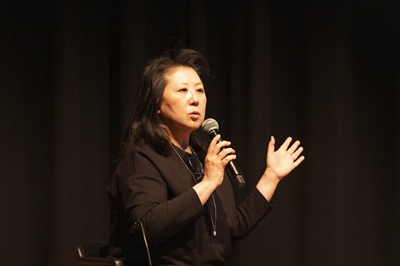
丹羽晴美(以下丹羽):皆様、お忙しいこの秋のアートシーズンに、今日お越しいただきありがとうございます。私は東京都写真美術館の事業企画課長の丹羽と申します。本日お招きしたのは、長野県立美術館の館長の笠原美智子さんです。笠原さんは、1989年に写真美術館の準備室がまだ丸の内の都庁の一室で始まった時の最初のメンバーでした。私はそこでアルバイトをしていて、その後職員になりましたので、本当に最初の先輩になります。当館は今年「30周年」と言っていますが、実は1980年代から準備が始まっており、本日は「40年史」のようなお話を伺う予定です。
笠原美智子(以下笠原):改めまして。「東京都写真美術館の笠原です」と未だに言ってしまいそうになるくらい、ここは実家のような存在です。私は1989年に東京都写真美術館の準備室に入り、3年9か月の現代美術館への異動期間以外は、2017年3月に定年退職するまで写真美術館におりました。私が社会人になったのは30歳の時です。本日はその活動をもとに、公立美術館における写真の可能性というテーマの下、「収集」と「展覧会」の二つのテーマに分けてお話しします。
設立の理念と初期の困難
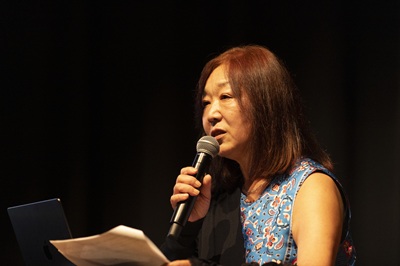
笠原:東京都が写真美術館を設立するきっかけとなったのは、1986年の第二次東京都長期計画における「写真文化施設の設置」の発表を受けたものです。しかし、その前段階として1978年から日本写真協会や日本写真家協会といった実際に写真を撮っている人たちによる強い働きかけがありました。彼らが望んでいたのは、野球の殿堂のような「写真家の殿堂」であり、私たちが目指した、収集・展示・教育普及、保存・修復といった機能を担う「美術館」としての国際的な基準との間には、設立準備当初から大きなずれが生じていました。
公立美術館として写真美術館が必要だったのは、当時の日本には「写真を扱うところがなかったから」です。例えば、ニューヨーク近代美術館(MoMA)では1940年に写真部門が設立されましたが、写真作品はMoMAの設立翌年(1930年)には既に作品として収集されていました。メトロポリタン美術館(The MET)も1928年に写真の収蔵を始めていますし、ロンドンのヴィクトリア・アンド・アルバート美術館(V&A)は1852年に写真の収蔵を開始しています。つまり、アメリカやヨーロッパでは、一般の総合美術館に写真部門があるため、専門の美術館を作る必要はありませんでした。日本固有の制度としての美術館やマーケットの未成熟さが、写真美術館を必要とした社会的背景です。
この日本特有の状況は、初期のコレクション政策に大きな困難を生みました。日本の写真文化自体は成熟していたものの、表現としての写真、つまりアーティストが集中して作品を制作し、それを扱うギャラリー(マーケット)が未成熟だったのです。そのため当時は作品の市場価格が存在しない状況でした。
苦肉の策として、美術館は謝礼として「協力価格」を導入しました。具体的には、1995年までに収集した15,032点のうち、国内作品約1万点については、一点あたり7万円という均一の謝礼を支払うことで収集されました。これは、マーケットが成熟していたらあり得ないことです。海外の作家についてはマーケット価格から3割程度の値引きをお願いして収集しましたが、海外のマーケットからは公立美術館が謝礼で収集すること自体を「正気か」と驚かれました。
この均一謝礼方式には問題があり、当時すでに市場で評価され始めていた杉本博司氏のような作家の作品は7万円では買えませんから後回しにされました。また、委員会の中に写真家がいたため、自分たちで選定し、自分たちの作品を収蔵するという事態が発生し、収集作品が1950年代、60年代ばかりに偏ってしまいました。実際、1万点のうち約70%が50年代・60年代の作品でした。
さらに、1999年石原慎太郎氏が知事に就任するとゼロになりました。当時の石原都知事からの言葉は「学芸員なんか便所掃除してればいいんだ」というものでした。館長に就任した福原義春氏は、この危機に対し、支援協議会というファンドレイジングの仕組みを作りました。いまだにこの東京都写真美術館の企画展予算はゼロであり、企画展の多くは支援協議会が集めたファンドで賄われています。収集予算は2006年に4,000万円まで回復しましたが、価格が高騰した現代において、初期の7万円均一の謝礼で作品を収集できた時代とは状況が大きく変わっています。
社会性を巡る展覧会活動:「ダブルスタンダードの目」との対峙
笠原:私の専門分野はアメリカの近現代、日本の現代写真、そしてジェンダーです。私は、公立美術館の学芸員として、1990年の一次開館以来、ジェンダー関係の展覧会を意図的に多く企画してきました。1970年代以降、多くの優れた女性作家が輩出していたのにもかかわらず、日本ではほとんど紹介されていないか、意図的にジェンダーの問題意識を省いて紹介されていたからです。
1991年に企画した「私という未知へ向かって 現代女性セルフ・ポートレイト」展では、アメリカ、イギリス、オランダ、ドイツ、日本など18人の女性作家で構成しました。わたしは知らなかったのですが、この展覧会は、日本において美術館における初めてのジェンダーの視点からの展覧会だと言われることになりました。
なぜ女性の「セルフ・ポートレート」が重要なのか。美術史や写真史の名作と言われてきた「女性の美」や「セクシュアリティ」は、実は男性から見た「女性の美」であり、彼らが創り出した「女性の理想像」だったからです。男性の観客のために男性の写真家が女性の身体で作ったものです。そうした作品に対して1970年代以降の女性作家が居心地の悪さを感じはじめました。
彼女たちは自分自身の意識の中に、家父長制社会によって植え付けられた「男性の眼」を自覚していました。これが、「ダブルスタンダード」です。
生まれた時から日々、家庭や学校、メディアを通じて、わたしたちは呼吸するように「男性の眼」で見ることを学びます。女性のモデルを使えば、従来の作家と同じことを繰り返しかねないと考え、多くの女性作家が、内面化された「二重基準(ダブルスタンダード)」を恐れ、自分自身をモデルにすることを選びました。
代表的な作家にシンディ・シャーマン(Cindy Sherman)がいます。彼女の《Untitled Film Still》は、1950年代のハリウッド映画における典型的な女性像を自身が演じたシリーズです。シャーマンは自分で典型的な女性像を演じることで、その歪みを問いました。ちなみに、この作品《Untitled Film Still #48》は、2015年に$2,900,000(当時のレート換算で約3億円)で取引された実績があります。この作品が出品された後、写真美術館はこのシリーズを一点30万円程度ですでに収集していました。ちなみに、杉本博司氏の劇場のシリーズも15点ほども同じく30万円くらいで収集しています。ちょっと自慢しますが、かなり東京都に貢献しています。新進作家の評価を行う「見る目が大事」であることを示していると思います。
ナン・ゴールディン(Nan Goldin)も、私が日本で最初に紹介した作家です。彼女はボストンの保守的な家庭に生まれ、レズビアンで反抗的だった姉は両親に理解されず自殺しました。姉と親密だったナン・ゴールディンも両親に反抗し、コミュニティ・スクールに半ば放り出されます。半年も口を利かなかったそうです。写真を知ることで徐々に自分を取り戻し、自身が属するコミュニティの私生活を日記のように撮りはじめます。時は1970年代後半から80年代、セックス・ドラッグ・ロックンロールの時代です。1986年に出版された写真集『性的依存のバラード』は、当時私が通っていたシカゴ・コロンビア・カレッジの大学院でも喧々囂々の議論を呼びました。
従来のドキュメンタリーは、第三者である写真家が客観的な立場で撮ることを前提としていました。ナン・ゴールディンの作品は当事者として、私生活をつぶさに撮り、特に女性が自身のセクシュアリティを奔放なまま自ら表すという行為は衝撃的でした。男性の観客がショックや反発を受けたのは、彼らがコントロールできる最後の領域だとされてきたセックスを、女性自身が堂々と表現したためです。彼女は従来信じられていた「客観的な立場」などないことも表しました。あるのはその写真を撮った人の立場です。その後の彼女の活躍は著しく、この写真集の発表翌年にはアルル国際写真フェスティバルに招聘され、2023年には美術界で最も力を持つ100人の一人に選出されています。
1991年の「セルフ・ポートレート」展が西洋の中産階級の白人女性中心だったという反省から、1996年には、より多角的な視点を取り入れた「ジェンダー 記憶の淵から」展を企画しました。ジェンダーの問題は、人種、民族、セクシュアリティ、年齢、身体の差異(病気など)、経済、政治的背景など、あらゆる要素と関わってきます。アジア、中東、アフリカの作家も選出しました。
この展覧会で紹介されたアフリカ系アメリカ人のキャリー・メイ・ウィームス(Carrie Mae Weems)の連作は、アメリカの白人男性が作り出したアフリカ系表象の歴史的な差別構造を痛烈に批判しています。日系アメリカ人のマスミ・ハヤシ(Masumi Hayashi)の作品は、ルーズベルト大統領の強制命令により日系人が収容された強制収容所の記憶とサバイバーの声をテーマにしました。カリフォルニア州が日系人強制収容所について謝罪表明をしたのは2020年です。
その後、1998年に「ラヴズ・ボディ ヌード写真の近現代」展を企画しましたが、そのテーマをさらに深めた「ラヴズ・ボディ 生と性を巡る表現」展(2010年)を開催するまでに12年もかかりました。なぜなら後者はエイズがいかに写真を変えたかを検証した展覧会でしたが、私はHIVポジティヴでも友だちにそうした人がいたわけでも、ゲイでもレズビアンでもない「非当事者」だったからです。ジェンダーの問題は、女性のイメージが男性によって、非白人のイメージが白人によって、障がい者のイメージが非障がい者によって、ゲイのイメージがヘテロによって作られてきたように、「他者表現の問題」です。当事者ではない私がキュレーションをして良いのか悩みましたが、他にやる人がいない、であればと実現に踏み切りました。この展覧会では、エイズで亡くなったデヴィッド・ヴォイナロヴィッチ(David Wojnarowicz)や、こちらも若くして亡くなったキューバ出身のフェリックス・ゴンザレス=トレス(Felix Gonzalez-Torres)、といった作家を紹介しました。
「戦い」の意義と写真美術館の未来
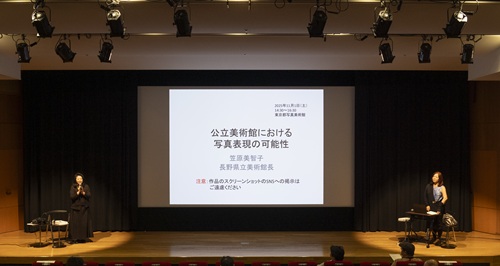
丹羽:笠原さんのレクチャーを初めて聞いた方は、そのものすごい情報量と、ある部分、深い話の説得力に驚かれたと思います。公立の東京都写真美術館が、どう望まれ、どう運営されてきたかというお話でした。
今の視点で90年代を見返しても、非常に多くの示唆や気づきがあります。今だからこそ、コンプライアンスが上がり、「いろんな人がいていい」と言える状況になりましたが、かつては、あえてこの言葉を使いますが「戦い」ながら、この美術館で展示をしてきました。
笠原:丹羽さんが「戦い」という言葉でまとめてくれましたが、女性の学芸員だから女性作家を評価する、という単純な話ではありません。美術史も写真史もずっと男性ばかりが評価されてきた歴史があり、女性であっても頭が男性的な価値観に支配されている人は多くいます。日本社会はジェンダーの問題について諸外国に比べて遅れているのは事実です。それに対して、優れた作家を評価していくためには、自覚的に学ばなければいけなかった。セクハラがやってはいけないことだと社会全体が学ばなければそれがストップしないのと同じです。展覧会を企画・実施するにも、社会で起こりつつあるパラダイムシフトを自覚してもらわなければいけなかった。その意味で「戦い」という表現になったのだと思います。
丹羽:私があえて「戦い」という言葉を使ったのは、笠原さんの展覧会が外部から見れば新鮮な印象だったとしても、内部から見ていた者として、それは一種の「戦い」だったと感じていたからです。展覧会を行うには私たち運営側だけで決めているわけではなく、外部の有識者の方々や行政など、多くの関係者との意見交換が必要です。例えば「風景論」のような企画はすんなり通るのに対し、社会的な課題を先んじて扱う展覧会を委員会で通すためには、発表した時のハレーションが起きた際の説明責任が問われます。そのため、何を質問されても、どこからどういう疑問が飛んできても、客観的な資料で示しながら、「今この展覧会をやるべきなのです」という説明を非常に冷静にしていく必要があった。そういった内部的な、研究者としての並々ならぬ努力も含めて、「戦い」だと感じていました。
「公立美術館の写真表現の可能性」というタイトルの内容に戻りますが、今でも総合的な各美術館で写真や映像の作品がコレクションされていけば、写真美術館は別になくてもいい、と思っていらっしゃいますでしょうか。
笠原:はい。日本の各美術館に写真部門があれば、この東京都写真美術館はいらなくなる。「多分それが一番いいことなのじゃないか」とコラムに書いたこともあります。
長野県立美術館の館長になる前に、アーティゾン美術館で副館長をやっていました。彼らが「現代」をやりたいということで私が呼ばれたのですけれども、実際は、アーティゾン美術館が扱う「現代」(印象派の後の保守的な現代)と、私が写真美術館で扱ってきた社会の最先端をいく「現代」(ジェンダーや社会課題に触れる表現)には極と極ほどの違いがありました。公立美術館は、たとえ自分が苦手な作家でも評価すべき人はしなければなりませんが、プライベート・コレクションにはトーン&マナーがあります。
私がアーティゾン美術館で副館長をしていた際、「ジャム・セッション」という枠組みを作りました。これは、現代という幅の広い表現に対応するため、キュレーターが選んだアーティスト、キュレーター、そして石橋財団コレクション(過去のコレクション)の三つ巴で展覧会を作るという試みです。
この展覧会は企画から開催まで大体3年ほどかかりますが、これは現代美術の領域を広げ、コレクションを過去の歴史としてではなく、現在と結びつけて活用する挑戦でした。このプログラムは、鴻池朋子さんや森村泰昌さん、鈴木理策さんや柴田敏夫さんや山口晃さん、また近年では毛利悠子さん、山城知佳子さんや志賀理江子さんといった、幅広い分野の作家たちが参加をしています。これらの展覧会は、一見、難解に見えたり、好みが分かれたりするかもしれませんが、常に「見る価値がある」と確信できる質の高い挑戦を続けています。
丹羽:笠原さんが行ってきたジェンダー関連の展覧会は、本当に美術館というところを越えて、社会に向けて風穴を開けるような活動だったのだと、今日お越しの皆様にも改めて共有できたと思います。
私たち後輩も頑張っています。笠原さんが築き上げ、私たちも「戦い」と表現してきた、社会的な課題に「風穴を開ける」キュレーションの精神は、この美術館の中で確かに受け継がれています。現在進行形の表現を追求し、国内外で高く評価される作家の作品を継続的に紹介しています。
例えば、笠原さんが企画された「セルフ・ポートレイト」展に参加された石内都さんの作品や、現代美術との接点を探るアーティゾン美術館の「ジャム・セッション」プログラムで成果を出している志賀理江子さんの作品は、当館の重要なコレクションとして、常に新しい文脈やフレームで展示されています。これは、写真・映像専門美術館として、歴史的な評価だけでなく、社会に鋭い問いを投げかける現在進行形の表現を、積極的かつ独自の視点から収集し、多様な視点から提示し続けるという、当館が果たすべき使命を象徴しています。
東京都写真美術館としては、今後もこの専門的な視点を堅持し、写真と映像の表現を、皆さんに身近に感じ、愛していただけることを願っております。
私たちも、30周年の今、ジェンダーやセクシュアリティの視点のみならず、さまざまな社会的な課題へアプローチするテーマを、遠くの人たちへも投げ込めるように作家の作品を収集し、展覧会も続けています。本日は本当に貴重なお話をありがとうございました。
TOP 30th Anniversary Talk Session
The Potential of Photographic Expression in Public Museums
–The Conflict with the Concept of “a Hall of Fame for Photographers,” the Collection’s “Supportive Pricing” and the Exhibition Practice that “Breakthrough” Society–
Date:
November 1, 2025, 14:30-16:30
Speakers:
Kasahara Michiko (Director of Nagano Prefectural Art Museum)
Niwa Harumi (Curator of Tokyo Photographic Art Museum, Moderator)
The 40-year history of the Tokyo Photographic Art Museum and the journey of the curators
Niwa Harumi (NH): Thank you for joining us today during this busy autumn art season. My name is Niwa, the Head of the Project Planning Department of the Tokyo Photographic Art Museum. We have invited here, Kasahara Michiko, director of the Nagano Prefectural Art Museum. She was one of the first members of the museum’s preparatory office established in 1989, in one of the rooms at the Tokyo Metropolitan Government Office in Marunouchi. I worked in the office as a part-time staff member, and later became a full-time employee; so, she was my very first mentor. Although we are calling this the 30th anniversary of the museum, its preparation began in the 1980s, which is why we hope to hear more about this “40-year history” in this session.
Kasahara Michiko (KM): Thank you for the introduction. This place feels like home, so much so that I might blurt out, “My name is Kasahara from the Tokyo Photographic Art Museum.” I joined the preparatory office for the museum in 1989, and aside from the 3 years and 9 months I was assigned to the Museum of Contemporary Art Tokyo, I was in this museum until my retirement in March 2017. I started working at age 30. I would like to speak about the possibility of photography in public museums from two perspectives, “collection” and “exhibitions,” based on my career experience.
The philosophy behind the establishment of the museum and the initial difficulties
KM: The Tokyo Metropolis decided to institute a photographic museum in response to the announcement of “the construction of an institution for photographic culture” within the Second Tokyo Long Term Planning in 1986. Yet, there was a strong lobbying since 1978, from the people actually taking the photographs, like the Photographic Society of Japan or the Japan Professional Photographers Society, as the preliminary step. What the people from such associations were looking for was a “Hall of Fame” for the photographers, just like in baseball. There was thus a wide gap between their wishes and the international standard of a “museum” with the function of collections, exhibitions, education, conservation, and restoration that we were aiming for at the outset of the museum’s establishment.
The reason behind the necessity for a public photography museum was that no other Japanese museum worked with photography back then. For example, the Museum of Modern Art in New York (MoMA) introduced its photography department in 1940, but the museum had already started collecting photographic works in 1930, the following year of its institution. The Metropolitan Museum (The MET) also founded the collection of photography in 1928, and the Victoria & Albert Museum (V&A) in London had begun as early as 1852. As the United States and Europe already had general museums with photographic departments like so, there was no need for them to build a specialized museum. The social background that necessitated a photography museum comes from the inexperience of museums and markets within a system unique to Japan.
This Japanese characteristic bore challenges in the formulation of the early collection policy. Although the Japanese photographic culture had matured, photography as a form of expression—the galleries (market) dealing works created by professional artists—was yet too young. Naturally, no market prices for artworks existed at the time.
As a last resort, the museum introduced what was called “supportive pricing” as a form of honorarium. More specifically, about 10,000 domestic works from the 15,032 pieces collected until 1995 were purchased with a uniform remuneration of 70,000 JPY per work. This would have been impossible if we had a mature market. Works by non-Japanese artists were collected, requesting a 30% discount from the market price. The international market thought it was crazy that a public museum was collecting works based on an honorarium.
This flat remuneration system had its problems; works by artists already recognized by the market, such as Sugimoto Hiroshi, could not be acquired with 70,000JPY, and these purchases were deferred. As we also had photographers in the committee, we faced a situation where they would select the photographs and include their own works in the collection. As a result, the collection became unbalanced, overflowing with works from the 1950s and 60s. In fact, out of the 10,000 pieces, about 70% were from the said period of time.
When Ishihara Shintaro was elected Governor of Tokyo in 1999, we had no more budget. The words by Ishihara back then were “curators should just be cleaning toilets.” Fukuhara Yoshiharu, appointed director of TOP, decided to create a fundraising system called the “Sustaining Member Program” to break through this threat. Even today, the budget given for the thematic exhibitions in TOP is null, and most of the shows are sustained by the funds gathered through the membership program. The budget for the collection recovered to 40 million JPY in 2006, but it is a very different situation from what it was in the early times, with the current soaring prices, when works could be acquired with a flat rate of 70,000 JPY.
The exhibitions exploring social natures: confronting the “eyes of the double standard”
KM: My field of speciality is American modern and contemporary photography, Japanese contemporary photography, and gender. As a curator of a public museum, I had consciously planned many gender-related exhibitions since the first opening of the museum in 1990. Regardless of the number of female artists that had emerged one after another since the 1970s, not many were introduced in Japan, or were showcased with the gender issue context deliberately excluded.
“Self-Portraits of Contemporary Women: Exploring the Unknown Self” which I curated in 1999, was composed of 18 female artists from the United States, the United Kingdom, the Netherlands, Germany, and Japan. Although I was not aware, this exhibition appears to be the first show in a Japanese museum themed on gender.
Why are self-portraits by women important? The “female beauty” or “sexuality” from the masterpieces in art or photographic history were all “beauty of women” seen from the male perspective, thus “the ideal image of a woman” that they have devised. They are images by male photographers for the male audience, using a female body. Female artists from the 1970s began to feel discomfort with such works.
They were aware of the “male gaze” inside their own mind, embedded by the patriarchal society. This is the “double standard.”
From the day we are born, we are taught to see with the “male gaze” as naturally as breathing, at home, or school, and through media, every day. For fear of their internalized “double standard” thinking that using female models may be repeating the same thing as the past photographers, female artists chose to pose themselves in the pictures.
One exemplary artist is Cindy Sherman. Her Untitled Film Still is a series in which she impersonates the typical female figures from 1950s Hollywood movies. By portraying the typical female roles, she questioned the distortion they depicted. On another note, the piece Untitled Film Still #48 was purchased for $2,900,000 (about 300 million JPY based on the exchange rate at the time) in 2015. When this work just appeared on the market, TOP had collected one picture from the same series for 300,000 JPY. We also have about 15 pieces of the theater series by Sugimoto Hiroshi, each at the same price. It is a small thing we are proud of, but as you can see, we have contributed a lot to the Tokyo Metropolis. It shows how important it is to have a good eye for evaluating emerging artists.
Nan Goldin is another artist I introduced in Japan. She was born in a conservative family in Boston. Her lesbian and rebellious older sister took her own life, unable to get their parents understanding. Very close to her sister, Nan Goldin herself opposed her parents and was sent to a community school—thrown out of the house, almost. They apparently didn’t speak for half a year. She was able to pull herself together by learning photography and started to capture the private lives of the community she belonged to, just like a diary. It was around the end 1970s to the 80s; the time of sex, drugs, rock and roll. The photobook The Ballad of Sexual Dependency published in 1986 had called heated debates even at Columbia College Chicago’s graduate School, where I studied at the time.
A classic documentary would be taken on the premise that the photographer, a third party, takes the picture from an objective point of view. Nan Goldin’s works capture the private lives in detail, despite her being a related party herself. The fact that a woman portrayed her sexuality extravagantly in her own work was shocking. The male audience was aghast and disputed her practice because a woman had expressed sex with confidence, the last territory the men thought they had control over. On the beat, she demonstrated that there is no objective standpoint previously believed to exist—all there is is the standpoint of the person taking the picture. The career that followed was remarkable. She was invited to the Rencontres d’Arles the year after the publication of her book, and in 2023, she was chosen as one of the hundred most influential people in the art industry.
Having reflected on the fact that the 1991 “Self-portraits” was an exhibition mainly featuring Western, middle-class, white women, I curated another show in 1996, “Gender—beyond memory: The Works of Contemporary Women Artists” incorporating a diversified point of view. The gender issues are intertwined with many other factors, like race, ethnicity, sexuality, age, physical differences (such as illness), economic status, and political background. We added artists from Asia, the Middle East, and Africa to the selection.
The series by Carrie Mae Weems, an African American artist showcased in this exhibition, fiercely criticizes the historical discriminatory structure of African representation created by white American men. The work by Masumi Hayashi, a Japanese American, is themed on the memory of Japanese Americans imprisoned in concentration camps under the strict order issued by President Roosevelt and the voices of their survivors. California State only released its public apology regarding the Japanese American concentration camps in 2020.
Later on, I curated “LOVE’s BODY: Rethinking Naked and Nude in Photography” in 1998, but it took me another 12 years to prepare for “love’s body: art in the age of AIDS” (2010) that delves deeper into the theme. I needed the time because although the latter exhibition inspected how AIDS changed photography, I myself was not HIV positive, nor had I had friends who were. I was not gay. I was not a related party to this topic. Gender issues are grounded in depictions by the outside party: the female image by males, the image of people of color by white people, the image of the disabled by the able-bodied, and the homosexual images by heterosexuals. I hesitated to take on this curation because I was not part of the party in question, but I decided to take the leap because no one else would. In this exhibition, I showcased works by artists like David Wojnarowicz, who died from AIDS, as well as Cuban artist Felix Gonzalez-Torres, who also passed away at a young age.
The significance of the “fight” and the future of the photographic museum
NH: For those who hear her lecture for the first time, you might be overwhelmed by the huge amount of information and the certain persuasiveness of the extensive topics. It provided an overview of what was anticipated of this public Tokyo Photographic Art Museum and how it was managed.
Even with a contemporary perspective, looking back on the 90s still unveils a great deal of insight and realization. General awareness has risen today, and it is easier for people to voice that diversity should be accepted. In the past—and I chose this word consciously—we were building the exhibitions through “fights.”
KM: Ms. Niwa has condensed it well into that one word, “fight,” but it’s also not a simple conversation of valuing female artists because we are female curators. This history of art and photography has always valued men, and many women are also mentally dominated by male values. Japanese society is clearly behind compared to other countries in terms of handling gender issues. To be able to appreciate the interesting artists meant that I had to learn with my eyes wide open. If the entire society doesn’t understand that sexual harassment is unacceptable, it’s the same as keeping it going. When planning and organizing an exhibition, we wanted the audience to recognize the paradigm shift occurring in society. I believe the word “fight” was used to express that notion.
NH: I chose the word “fight” because her exhibitions seen from the outside may seem new, but as one who has seen what was going on behind the scenes, I personally experienced it as a sort of “fight.” When building an exhibition, we have to hold an extensive exchange of opinions with related parties, including an expert panel and members of the administration, and we cannot make the decisions on our own as the organizer. While programs themed on “theories of landscape” are easily accepted, for the committee to agree on showing works that take the initiative to address social issues, we are required to provide an explanation for the possible troubles that may arise upon the opening of the show. We needed to explain “the significance of this exhibition today” with composure, referencing objective materials and to answer all possible questions or doubts. I had felt the “fight” within the internal line of duty, not to mention her outstanding undertaking as a researcher.
Going back to the title “The Potential of Photographic Expression in Public Museums,” do you still believe that there is no longer a need for a photography museum if each general art museum owned a collection of photography or moving images?
KM: Yes, I do think that we will not need the Tokyo Photographic Art Museum if each museum in Japan had a photography department. I once wrote in a column that it might be the best situation.
Before I became director of the Nagano Prefectural Art Museum, I was the assistant director of the Artizon Museum. I was appointed because the museum wanted to showcase the “contemporary,” but there was a world of difference between the contemporary they were actually envisioning—a more conservative contemporary after the Impressionism—and the contemporary at the forefront of society I was working with at TOP—practice on gender and social issues. In public museums, one must acknowledge the artists who deserve recognition, regardless of your own personal preference, whereas private collections have a certain tone and style to follow.
When I was working as the assistant director at the Artizon Museum, I created this framework called the “Jam Session.” This was an attempt to build an exhibition with the artists chosen by the curator, the curator, and the Collection Ishibashi Foundation (past collection) to accommodate the diverse practices within contemporary art.
The program runs for about 3 years from planning to opening the exhibition; it was an endeavor to expand the field of contemporary art and to utilize the collection not as a history of the past, but by connecting it to the present. Artists of diverse practice have joined this program, including Konoike Tomoko, Morimura Yasumasa, Suzuki Risaku, Shibata Toshio, Yamaguchi Akira, as well as Mohri Yuko, Yamashiro Chikako, and Shiga Rieko in recent years. These shows might at first seem complex and choosing their audience, yet they continuously aim for the finest challenges, always building an exhibition definitely “worth seeing.”
NH: I think that we were able to recognize once again with the audience here today that the gender-related exhibitions you curated have broken through society, going beyond the boundaries of museums.
We, as your successors, are working hard today; the spirit of a curation breaking through social issues—what you have established and what we call the “fight”—is indeed passed down within this museum. Pursuing the ongoing forms of expression, we continuously showcase works of artists who are acknowledged domestically and internationally.
For instance, the works of Ishiuchi Miyako, who participated in the “Self-Portraits” exhibition you curated, or of Shiga Rieko, who has shown considerable achievement in the Jam Session program exploring the connection to contemporary art at the Artizon Museum, are an important part of our collection, constantly re-exhibited in a renewed context or framework. It symbolizes the mission that we must achieve as a museum specializing in photography and moving images—one that looks beyond historical values, actively building a collection from a unique perspective with current practices encompassing insightful questions against society, and presenting them through diverse contexts.
At the Tokyo Photographic Art Museum, we hope to hold onto this specialized perspective so that everyone can familiarize and cherish the art of photography and moving images.
Today, on our 30th anniversary, we continue collecting artists' works and opening exhibitions that address a variety of social issues, including but not limited to gender and sexuality, to reach even the furthest audience. Thank you very much for your precious insight today.
公立美術館における写真表現の可能性
— 「写真家の殿堂」構想との葛藤、コレクションの「協力価格」と社会に「風穴を開ける」展覧会活動 —
日時:
2025年11月1日(土)14:30-16:30
登壇者:
笠原美智子(長野県立美術館長)
丹羽 晴美(東京都写真美術館 主任学芸員)
東京都写真美術館40年史とキュレーターの軌跡
丹羽晴美(以下丹羽):皆様、お忙しいこの秋のアートシーズンに、今日お越しいただきありがとうございます。私は東京都写真美術館の事業企画課長の丹羽と申します。本日お招きしたのは、長野県立美術館の館長の笠原美智子さんです。笠原さんは、1989年に写真美術館の準備室がまだ丸の内の都庁の一室で始まった時の最初のメンバーでした。私はそこでアルバイトをしていて、その後職員になりましたので、本当に最初の先輩になります。当館は今年「30周年」と言っていますが、実は1980年代から準備が始まっており、本日は「40年史」のようなお話を伺う予定です。
笠原美智子(以下笠原):改めまして。「東京都写真美術館の笠原です」と未だに言ってしまいそうになるくらい、ここは実家のような存在です。私は1989年に東京都写真美術館の準備室に入り、3年9か月の現代美術館への異動期間以外は、2017年3月に定年退職するまで写真美術館におりました。私が社会人になったのは30歳の時です。本日はその活動をもとに、公立美術館における写真の可能性というテーマの下、「収集」と「展覧会」の二つのテーマに分けてお話しします。
設立の理念と初期の困難
笠原:東京都が写真美術館を設立するきっかけとなったのは、1986年の第二次東京都長期計画における「写真文化施設の設置」の発表を受けたものです。しかし、その前段階として1978年から日本写真協会や日本写真家協会といった実際に写真を撮っている人たちによる強い働きかけがありました。彼らが望んでいたのは、野球の殿堂のような「写真家の殿堂」であり、私たちが目指した、収集・展示・教育普及、保存・修復といった機能を担う「美術館」としての国際的な基準との間には、設立準備当初から大きなずれが生じていました。
公立美術館として写真美術館が必要だったのは、当時の日本には「写真を扱うところがなかったから」です。例えば、ニューヨーク近代美術館(MoMA)では1940年に写真部門が設立されましたが、写真作品はMoMAの設立翌年(1930年)には既に作品として収集されていました。メトロポリタン美術館(The MET)も1928年に写真の収蔵を始めていますし、ロンドンのヴィクトリア・アンド・アルバート美術館(V&A)は1852年に写真の収蔵を開始しています。つまり、アメリカやヨーロッパでは、一般の総合美術館に写真部門があるため、専門の美術館を作る必要はありませんでした。日本固有の制度としての美術館やマーケットの未成熟さが、写真美術館を必要とした社会的背景です。
この日本特有の状況は、初期のコレクション政策に大きな困難を生みました。日本の写真文化自体は成熟していたものの、表現としての写真、つまりアーティストが集中して作品を制作し、それを扱うギャラリー(マーケット)が未成熟だったのです。そのため当時は作品の市場価格が存在しない状況でした。
苦肉の策として、美術館は謝礼として「協力価格」を導入しました。具体的には、1995年までに収集した15,032点のうち、国内作品約1万点については、一点あたり7万円という均一の謝礼を支払うことで収集されました。これは、マーケットが成熟していたらあり得ないことです。海外の作家についてはマーケット価格から3割程度の値引きをお願いして収集しましたが、海外のマーケットからは公立美術館が謝礼で収集すること自体を「正気か」と驚かれました。
この均一謝礼方式には問題があり、当時すでに市場で評価され始めていた杉本博司氏のような作家の作品は7万円では買えませんから後回しにされました。また、委員会の中に写真家がいたため、自分たちで選定し、自分たちの作品を収蔵するという事態が発生し、収集作品が1950年代、60年代ばかりに偏ってしまいました。実際、1万点のうち約70%が50年代・60年代の作品でした。
さらに、1999年石原慎太郎氏が知事に就任するとゼロになりました。当時の石原都知事からの言葉は「学芸員なんか便所掃除してればいいんだ」というものでした。館長に就任した福原義春氏は、この危機に対し、支援協議会というファンドレイジングの仕組みを作りました。いまだにこの東京都写真美術館の企画展予算はゼロであり、企画展の多くは支援協議会が集めたファンドで賄われています。収集予算は2006年に4,000万円まで回復しましたが、価格が高騰した現代において、初期の7万円均一の謝礼で作品を収集できた時代とは状況が大きく変わっています。
社会性を巡る展覧会活動:「ダブルスタンダードの目」との対峙
笠原:私の専門分野はアメリカの近現代、日本の現代写真、そしてジェンダーです。私は、公立美術館の学芸員として、1990年の一次開館以来、ジェンダー関係の展覧会を意図的に多く企画してきました。1970年代以降、多くの優れた女性作家が輩出していたのにもかかわらず、日本ではほとんど紹介されていないか、意図的にジェンダーの問題意識を省いて紹介されていたからです。
1991年に企画した「私という未知へ向かって 現代女性セルフ・ポートレイト」展では、アメリカ、イギリス、オランダ、ドイツ、日本など18人の女性作家で構成しました。わたしは知らなかったのですが、この展覧会は、日本において美術館における初めてのジェンダーの視点からの展覧会だと言われることになりました。
なぜ女性の「セルフ・ポートレート」が重要なのか。美術史や写真史の名作と言われてきた「女性の美」や「セクシュアリティ」は、実は男性から見た「女性の美」であり、彼らが創り出した「女性の理想像」だったからです。男性の観客のために男性の写真家が女性の身体で作ったものです。そうした作品に対して1970年代以降の女性作家が居心地の悪さを感じはじめました。
彼女たちは自分自身の意識の中に、家父長制社会によって植え付けられた「男性の眼」を自覚していました。これが、「ダブルスタンダード」です。
生まれた時から日々、家庭や学校、メディアを通じて、わたしたちは呼吸するように「男性の眼」で見ることを学びます。女性のモデルを使えば、従来の作家と同じことを繰り返しかねないと考え、多くの女性作家が、内面化された「二重基準(ダブルスタンダード)」を恐れ、自分自身をモデルにすることを選びました。
代表的な作家にシンディ・シャーマン(Cindy Sherman)がいます。彼女の《Untitled Film Still》は、1950年代のハリウッド映画における典型的な女性像を自身が演じたシリーズです。シャーマンは自分で典型的な女性像を演じることで、その歪みを問いました。ちなみに、この作品《Untitled Film Still #48》は、2015年に$2,900,000(当時のレート換算で約3億円)で取引された実績があります。この作品が出品された後、写真美術館はこのシリーズを一点30万円程度ですでに収集していました。ちなみに、杉本博司氏の劇場のシリーズも15点ほども同じく30万円くらいで収集しています。ちょっと自慢しますが、かなり東京都に貢献しています。新進作家の評価を行う「見る目が大事」であることを示していると思います。
ナン・ゴールディン(Nan Goldin)も、私が日本で最初に紹介した作家です。彼女はボストンの保守的な家庭に生まれ、レズビアンで反抗的だった姉は両親に理解されず自殺しました。姉と親密だったナン・ゴールディンも両親に反抗し、コミュニティ・スクールに半ば放り出されます。半年も口を利かなかったそうです。写真を知ることで徐々に自分を取り戻し、自身が属するコミュニティの私生活を日記のように撮りはじめます。時は1970年代後半から80年代、セックス・ドラッグ・ロックンロールの時代です。1986年に出版された写真集『性的依存のバラード』は、当時私が通っていたシカゴ・コロンビア・カレッジの大学院でも喧々囂々の議論を呼びました。
従来のドキュメンタリーは、第三者である写真家が客観的な立場で撮ることを前提としていました。ナン・ゴールディンの作品は当事者として、私生活をつぶさに撮り、特に女性が自身のセクシュアリティを奔放なまま自ら表すという行為は衝撃的でした。男性の観客がショックや反発を受けたのは、彼らがコントロールできる最後の領域だとされてきたセックスを、女性自身が堂々と表現したためです。彼女は従来信じられていた「客観的な立場」などないことも表しました。あるのはその写真を撮った人の立場です。その後の彼女の活躍は著しく、この写真集の発表翌年にはアルル国際写真フェスティバルに招聘され、2023年には美術界で最も力を持つ100人の一人に選出されています。
1991年の「セルフ・ポートレート」展が西洋の中産階級の白人女性中心だったという反省から、1996年には、より多角的な視点を取り入れた「ジェンダー 記憶の淵から」展を企画しました。ジェンダーの問題は、人種、民族、セクシュアリティ、年齢、身体の差異(病気など)、経済、政治的背景など、あらゆる要素と関わってきます。アジア、中東、アフリカの作家も選出しました。
この展覧会で紹介されたアフリカ系アメリカ人のキャリー・メイ・ウィームス(Carrie Mae Weems)の連作は、アメリカの白人男性が作り出したアフリカ系表象の歴史的な差別構造を痛烈に批判しています。日系アメリカ人のマスミ・ハヤシ(Masumi Hayashi)の作品は、ルーズベルト大統領の強制命令により日系人が収容された強制収容所の記憶とサバイバーの声をテーマにしました。カリフォルニア州が日系人強制収容所について謝罪表明をしたのは2020年です。
その後、1998年に「ラヴズ・ボディ ヌード写真の近現代」展を企画しましたが、そのテーマをさらに深めた「ラヴズ・ボディ 生と性を巡る表現」展(2010年)を開催するまでに12年もかかりました。なぜなら後者はエイズがいかに写真を変えたかを検証した展覧会でしたが、私はHIVポジティヴでも友だちにそうした人がいたわけでも、ゲイでもレズビアンでもない「非当事者」だったからです。ジェンダーの問題は、女性のイメージが男性によって、非白人のイメージが白人によって、障がい者のイメージが非障がい者によって、ゲイのイメージがヘテロによって作られてきたように、「他者表現の問題」です。当事者ではない私がキュレーションをして良いのか悩みましたが、他にやる人がいない、であればと実現に踏み切りました。この展覧会では、エイズで亡くなったデヴィッド・ヴォイナロヴィッチ(David Wojnarowicz)や、こちらも若くして亡くなったキューバ出身のフェリックス・ゴンザレス=トレス(Felix Gonzalez-Torres)、といった作家を紹介しました。
「戦い」の意義と写真美術館の未来
丹羽:笠原さんのレクチャーを初めて聞いた方は、そのものすごい情報量と、ある部分、深い話の説得力に驚かれたと思います。公立の東京都写真美術館が、どう望まれ、どう運営されてきたかというお話でした。
今の視点で90年代を見返しても、非常に多くの示唆や気づきがあります。今だからこそ、コンプライアンスが上がり、「いろんな人がいていい」と言える状況になりましたが、かつては、あえてこの言葉を使いますが「戦い」ながら、この美術館で展示をしてきました。
笠原:丹羽さんが「戦い」という言葉でまとめてくれましたが、女性の学芸員だから女性作家を評価する、という単純な話ではありません。美術史も写真史もずっと男性ばかりが評価されてきた歴史があり、女性であっても頭が男性的な価値観に支配されている人は多くいます。日本社会はジェンダーの問題について諸外国に比べて遅れているのは事実です。それに対して、優れた作家を評価していくためには、自覚的に学ばなければいけなかった。セクハラがやってはいけないことだと社会全体が学ばなければそれがストップしないのと同じです。展覧会を企画・実施するにも、社会で起こりつつあるパラダイムシフトを自覚してもらわなければいけなかった。その意味で「戦い」という表現になったのだと思います。
丹羽:私があえて「戦い」という言葉を使ったのは、笠原さんの展覧会が外部から見れば新鮮な印象だったとしても、内部から見ていた者として、それは一種の「戦い」だったと感じていたからです。展覧会を行うには私たち運営側だけで決めているわけではなく、外部の有識者の方々や行政など、多くの関係者との意見交換が必要です。例えば「風景論」のような企画はすんなり通るのに対し、社会的な課題を先んじて扱う展覧会を委員会で通すためには、発表した時のハレーションが起きた際の説明責任が問われます。そのため、何を質問されても、どこからどういう疑問が飛んできても、客観的な資料で示しながら、「今この展覧会をやるべきなのです」という説明を非常に冷静にしていく必要があった。そういった内部的な、研究者としての並々ならぬ努力も含めて、「戦い」だと感じていました。
「公立美術館の写真表現の可能性」というタイトルの内容に戻りますが、今でも総合的な各美術館で写真や映像の作品がコレクションされていけば、写真美術館は別になくてもいい、と思っていらっしゃいますでしょうか。
笠原:はい。日本の各美術館に写真部門があれば、この東京都写真美術館はいらなくなる。「多分それが一番いいことなのじゃないか」とコラムに書いたこともあります。
長野県立美術館の館長になる前に、アーティゾン美術館で副館長をやっていました。彼らが「現代」をやりたいということで私が呼ばれたのですけれども、実際は、アーティゾン美術館が扱う「現代」(印象派の後の保守的な現代)と、私が写真美術館で扱ってきた社会の最先端をいく「現代」(ジェンダーや社会課題に触れる表現)には極と極ほどの違いがありました。公立美術館は、たとえ自分が苦手な作家でも評価すべき人はしなければなりませんが、プライベート・コレクションにはトーン&マナーがあります。
私がアーティゾン美術館で副館長をしていた際、「ジャム・セッション」という枠組みを作りました。これは、現代という幅の広い表現に対応するため、キュレーターが選んだアーティスト、キュレーター、そして石橋財団コレクション(過去のコレクション)の三つ巴で展覧会を作るという試みです。
この展覧会は企画から開催まで大体3年ほどかかりますが、これは現代美術の領域を広げ、コレクションを過去の歴史としてではなく、現在と結びつけて活用する挑戦でした。このプログラムは、鴻池朋子さんや森村泰昌さん、鈴木理策さんや柴田敏夫さんや山口晃さん、また近年では毛利悠子さん、山城知佳子さんや志賀理江子さんといった、幅広い分野の作家たちが参加をしています。これらの展覧会は、一見、難解に見えたり、好みが分かれたりするかもしれませんが、常に「見る価値がある」と確信できる質の高い挑戦を続けています。
丹羽:笠原さんが行ってきたジェンダー関連の展覧会は、本当に美術館というところを越えて、社会に向けて風穴を開けるような活動だったのだと、今日お越しの皆様にも改めて共有できたと思います。
私たち後輩も頑張っています。笠原さんが築き上げ、私たちも「戦い」と表現してきた、社会的な課題に「風穴を開ける」キュレーションの精神は、この美術館の中で確かに受け継がれています。現在進行形の表現を追求し、国内外で高く評価される作家の作品を継続的に紹介しています。
例えば、笠原さんが企画された「セルフ・ポートレイト」展に参加された石内都さんの作品や、現代美術との接点を探るアーティゾン美術館の「ジャム・セッション」プログラムで成果を出している志賀理江子さんの作品は、当館の重要なコレクションとして、常に新しい文脈やフレームで展示されています。これは、写真・映像専門美術館として、歴史的な評価だけでなく、社会に鋭い問いを投げかける現在進行形の表現を、積極的かつ独自の視点から収集し、多様な視点から提示し続けるという、当館が果たすべき使命を象徴しています。
東京都写真美術館としては、今後もこの専門的な視点を堅持し、写真と映像の表現を、皆さんに身近に感じ、愛していただけることを願っております。
私たちも、30周年の今、ジェンダーやセクシュアリティの視点のみならず、さまざまな社会的な課題へアプローチするテーマを、遠くの人たちへも投げ込めるように作家の作品を収集し、展覧会も続けています。本日は本当に貴重なお話をありがとうございました。
TOP 30th Anniversary Talk Session
The Potential of Photographic Expression in Public Museums
–The Conflict with the Concept of “a Hall of Fame for Photographers,” the Collection’s “Supportive Pricing” and the Exhibition Practice that “Breakthrough” Society–
Date:
November 1, 2025, 14:30-16:30
Speakers:
Kasahara Michiko (Director of Nagano Prefectural Art Museum)
Niwa Harumi (Curator of Tokyo Photographic Art Museum, Moderator)
The 40-year history of the Tokyo Photographic Art Museum and the journey of the curators
Niwa Harumi (NH): Thank you for joining us today during this busy autumn art season. My name is Niwa, the Head of the Project Planning Department of the Tokyo Photographic Art Museum. We have invited here, Kasahara Michiko, director of the Nagano Prefectural Art Museum. She was one of the first members of the museum’s preparatory office established in 1989, in one of the rooms at the Tokyo Metropolitan Government Office in Marunouchi. I worked in the office as a part-time staff member, and later became a full-time employee; so, she was my very first mentor. Although we are calling this the 30th anniversary of the museum, its preparation began in the 1980s, which is why we hope to hear more about this “40-year history” in this session.
Kasahara Michiko (KM): Thank you for the introduction. This place feels like home, so much so that I might blurt out, “My name is Kasahara from the Tokyo Photographic Art Museum.” I joined the preparatory office for the museum in 1989, and aside from the 3 years and 9 months I was assigned to the Museum of Contemporary Art Tokyo, I was in this museum until my retirement in March 2017. I started working at age 30. I would like to speak about the possibility of photography in public museums from two perspectives, “collection” and “exhibitions,” based on my career experience.
The philosophy behind the establishment of the museum and the initial difficulties
KM: The Tokyo Metropolis decided to institute a photographic museum in response to the announcement of “the construction of an institution for photographic culture” within the Second Tokyo Long Term Planning in 1986. Yet, there was a strong lobbying since 1978, from the people actually taking the photographs, like the Photographic Society of Japan or the Japan Professional Photographers Society, as the preliminary step. What the people from such associations were looking for was a “Hall of Fame” for the photographers, just like in baseball. There was thus a wide gap between their wishes and the international standard of a “museum” with the function of collections, exhibitions, education, conservation, and restoration that we were aiming for at the outset of the museum’s establishment.
The reason behind the necessity for a public photography museum was that no other Japanese museum worked with photography back then. For example, the Museum of Modern Art in New York (MoMA) introduced its photography department in 1940, but the museum had already started collecting photographic works in 1930, the following year of its institution. The Metropolitan Museum (The MET) also founded the collection of photography in 1928, and the Victoria & Albert Museum (V&A) in London had begun as early as 1852. As the United States and Europe already had general museums with photographic departments like so, there was no need for them to build a specialized museum. The social background that necessitated a photography museum comes from the inexperience of museums and markets within a system unique to Japan.
This Japanese characteristic bore challenges in the formulation of the early collection policy. Although the Japanese photographic culture had matured, photography as a form of expression—the galleries (market) dealing works created by professional artists—was yet too young. Naturally, no market prices for artworks existed at the time.
As a last resort, the museum introduced what was called “supportive pricing” as a form of honorarium. More specifically, about 10,000 domestic works from the 15,032 pieces collected until 1995 were purchased with a uniform remuneration of 70,000 JPY per work. This would have been impossible if we had a mature market. Works by non-Japanese artists were collected, requesting a 30% discount from the market price. The international market thought it was crazy that a public museum was collecting works based on an honorarium.
This flat remuneration system had its problems; works by artists already recognized by the market, such as Sugimoto Hiroshi, could not be acquired with 70,000JPY, and these purchases were deferred. As we also had photographers in the committee, we faced a situation where they would select the photographs and include their own works in the collection. As a result, the collection became unbalanced, overflowing with works from the 1950s and 60s. In fact, out of the 10,000 pieces, about 70% were from the said period of time.
When Ishihara Shintaro was elected Governor of Tokyo in 1999, we had no more budget. The words by Ishihara back then were “curators should just be cleaning toilets.” Fukuhara Yoshiharu, appointed director of TOP, decided to create a fundraising system called the “Sustaining Member Program” to break through this threat. Even today, the budget given for the thematic exhibitions in TOP is null, and most of the shows are sustained by the funds gathered through the membership program. The budget for the collection recovered to 40 million JPY in 2006, but it is a very different situation from what it was in the early times, with the current soaring prices, when works could be acquired with a flat rate of 70,000 JPY.
The exhibitions exploring social natures: confronting the “eyes of the double standard”
KM: My field of speciality is American modern and contemporary photography, Japanese contemporary photography, and gender. As a curator of a public museum, I had consciously planned many gender-related exhibitions since the first opening of the museum in 1990. Regardless of the number of female artists that had emerged one after another since the 1970s, not many were introduced in Japan, or were showcased with the gender issue context deliberately excluded.
“Self-Portraits of Contemporary Women: Exploring the Unknown Self” which I curated in 1999, was composed of 18 female artists from the United States, the United Kingdom, the Netherlands, Germany, and Japan. Although I was not aware, this exhibition appears to be the first show in a Japanese museum themed on gender.
Why are self-portraits by women important? The “female beauty” or “sexuality” from the masterpieces in art or photographic history were all “beauty of women” seen from the male perspective, thus “the ideal image of a woman” that they have devised. They are images by male photographers for the male audience, using a female body. Female artists from the 1970s began to feel discomfort with such works.
They were aware of the “male gaze” inside their own mind, embedded by the patriarchal society. This is the “double standard.”
From the day we are born, we are taught to see with the “male gaze” as naturally as breathing, at home, or school, and through media, every day. For fear of their internalized “double standard” thinking that using female models may be repeating the same thing as the past photographers, female artists chose to pose themselves in the pictures.
One exemplary artist is Cindy Sherman. Her Untitled Film Still is a series in which she impersonates the typical female figures from 1950s Hollywood movies. By portraying the typical female roles, she questioned the distortion they depicted. On another note, the piece Untitled Film Still #48 was purchased for $2,900,000 (about 300 million JPY based on the exchange rate at the time) in 2015. When this work just appeared on the market, TOP had collected one picture from the same series for 300,000 JPY. We also have about 15 pieces of the theater series by Sugimoto Hiroshi, each at the same price. It is a small thing we are proud of, but as you can see, we have contributed a lot to the Tokyo Metropolis. It shows how important it is to have a good eye for evaluating emerging artists.
Nan Goldin is another artist I introduced in Japan. She was born in a conservative family in Boston. Her lesbian and rebellious older sister took her own life, unable to get their parents understanding. Very close to her sister, Nan Goldin herself opposed her parents and was sent to a community school—thrown out of the house, almost. They apparently didn’t speak for half a year. She was able to pull herself together by learning photography and started to capture the private lives of the community she belonged to, just like a diary. It was around the end 1970s to the 80s; the time of sex, drugs, rock and roll. The photobook The Ballad of Sexual Dependency published in 1986 had called heated debates even at Columbia College Chicago’s graduate School, where I studied at the time.
A classic documentary would be taken on the premise that the photographer, a third party, takes the picture from an objective point of view. Nan Goldin’s works capture the private lives in detail, despite her being a related party herself. The fact that a woman portrayed her sexuality extravagantly in her own work was shocking. The male audience was aghast and disputed her practice because a woman had expressed sex with confidence, the last territory the men thought they had control over. On the beat, she demonstrated that there is no objective standpoint previously believed to exist—all there is is the standpoint of the person taking the picture. The career that followed was remarkable. She was invited to the Rencontres d’Arles the year after the publication of her book, and in 2023, she was chosen as one of the hundred most influential people in the art industry.
Having reflected on the fact that the 1991 “Self-portraits” was an exhibition mainly featuring Western, middle-class, white women, I curated another show in 1996, “Gender—beyond memory: The Works of Contemporary Women Artists” incorporating a diversified point of view. The gender issues are intertwined with many other factors, like race, ethnicity, sexuality, age, physical differences (such as illness), economic status, and political background. We added artists from Asia, the Middle East, and Africa to the selection.
The series by Carrie Mae Weems, an African American artist showcased in this exhibition, fiercely criticizes the historical discriminatory structure of African representation created by white American men. The work by Masumi Hayashi, a Japanese American, is themed on the memory of Japanese Americans imprisoned in concentration camps under the strict order issued by President Roosevelt and the voices of their survivors. California State only released its public apology regarding the Japanese American concentration camps in 2020.
Later on, I curated “LOVE’s BODY: Rethinking Naked and Nude in Photography” in 1998, but it took me another 12 years to prepare for “love’s body: art in the age of AIDS” (2010) that delves deeper into the theme. I needed the time because although the latter exhibition inspected how AIDS changed photography, I myself was not HIV positive, nor had I had friends who were. I was not gay. I was not a related party to this topic. Gender issues are grounded in depictions by the outside party: the female image by males, the image of people of color by white people, the image of the disabled by the able-bodied, and the homosexual images by heterosexuals. I hesitated to take on this curation because I was not part of the party in question, but I decided to take the leap because no one else would. In this exhibition, I showcased works by artists like David Wojnarowicz, who died from AIDS, as well as Cuban artist Felix Gonzalez-Torres, who also passed away at a young age.
The significance of the “fight” and the future of the photographic museum
NH: For those who hear her lecture for the first time, you might be overwhelmed by the huge amount of information and the certain persuasiveness of the extensive topics. It provided an overview of what was anticipated of this public Tokyo Photographic Art Museum and how it was managed.
Even with a contemporary perspective, looking back on the 90s still unveils a great deal of insight and realization. General awareness has risen today, and it is easier for people to voice that diversity should be accepted. In the past—and I chose this word consciously—we were building the exhibitions through “fights.”
KM: Ms. Niwa has condensed it well into that one word, “fight,” but it’s also not a simple conversation of valuing female artists because we are female curators. This history of art and photography has always valued men, and many women are also mentally dominated by male values. Japanese society is clearly behind compared to other countries in terms of handling gender issues. To be able to appreciate the interesting artists meant that I had to learn with my eyes wide open. If the entire society doesn’t understand that sexual harassment is unacceptable, it’s the same as keeping it going. When planning and organizing an exhibition, we wanted the audience to recognize the paradigm shift occurring in society. I believe the word “fight” was used to express that notion.
NH: I chose the word “fight” because her exhibitions seen from the outside may seem new, but as one who has seen what was going on behind the scenes, I personally experienced it as a sort of “fight.” When building an exhibition, we have to hold an extensive exchange of opinions with related parties, including an expert panel and members of the administration, and we cannot make the decisions on our own as the organizer. While programs themed on “theories of landscape” are easily accepted, for the committee to agree on showing works that take the initiative to address social issues, we are required to provide an explanation for the possible troubles that may arise upon the opening of the show. We needed to explain “the significance of this exhibition today” with composure, referencing objective materials and to answer all possible questions or doubts. I had felt the “fight” within the internal line of duty, not to mention her outstanding undertaking as a researcher.
Going back to the title “The Potential of Photographic Expression in Public Museums,” do you still believe that there is no longer a need for a photography museum if each general art museum owned a collection of photography or moving images?
KM: Yes, I do think that we will not need the Tokyo Photographic Art Museum if each museum in Japan had a photography department. I once wrote in a column that it might be the best situation.
Before I became director of the Nagano Prefectural Art Museum, I was the assistant director of the Artizon Museum. I was appointed because the museum wanted to showcase the “contemporary,” but there was a world of difference between the contemporary they were actually envisioning—a more conservative contemporary after the Impressionism—and the contemporary at the forefront of society I was working with at TOP—practice on gender and social issues. In public museums, one must acknowledge the artists who deserve recognition, regardless of your own personal preference, whereas private collections have a certain tone and style to follow.
When I was working as the assistant director at the Artizon Museum, I created this framework called the “Jam Session.” This was an attempt to build an exhibition with the artists chosen by the curator, the curator, and the Collection Ishibashi Foundation (past collection) to accommodate the diverse practices within contemporary art.
The program runs for about 3 years from planning to opening the exhibition; it was an endeavor to expand the field of contemporary art and to utilize the collection not as a history of the past, but by connecting it to the present. Artists of diverse practice have joined this program, including Konoike Tomoko, Morimura Yasumasa, Suzuki Risaku, Shibata Toshio, Yamaguchi Akira, as well as Mohri Yuko, Yamashiro Chikako, and Shiga Rieko in recent years. These shows might at first seem complex and choosing their audience, yet they continuously aim for the finest challenges, always building an exhibition definitely “worth seeing.”
NH: I think that we were able to recognize once again with the audience here today that the gender-related exhibitions you curated have broken through society, going beyond the boundaries of museums.
We, as your successors, are working hard today; the spirit of a curation breaking through social issues—what you have established and what we call the “fight”—is indeed passed down within this museum. Pursuing the ongoing forms of expression, we continuously showcase works of artists who are acknowledged domestically and internationally.
For instance, the works of Ishiuchi Miyako, who participated in the “Self-Portraits” exhibition you curated, or of Shiga Rieko, who has shown considerable achievement in the Jam Session program exploring the connection to contemporary art at the Artizon Museum, are an important part of our collection, constantly re-exhibited in a renewed context or framework. It symbolizes the mission that we must achieve as a museum specializing in photography and moving images—one that looks beyond historical values, actively building a collection from a unique perspective with current practices encompassing insightful questions against society, and presenting them through diverse contexts.
At the Tokyo Photographic Art Museum, we hope to hold onto this specialized perspective so that everyone can familiarize and cherish the art of photography and moving images.
Today, on our 30th anniversary, we continue collecting artists' works and opening exhibitions that address a variety of social issues, including but not limited to gender and sexuality, to reach even the furthest audience. Thank you very much for your precious insight today.