
総合開館30周年記念スペシャル
総合開館30周年記念 トークセッション 写真・映像とこれからの30年
ロクサーナ・マルコチ氏 スペシャルトーク
日 時:
2025年10月9日(木)14:00-16:00
登壇者:
ロクサーナ・マルコチ(ニューヨーク近代美術館 キュレーター)
丹羽 晴美(東京都写真美術館 主任学芸員)
I. MoMAのコレクション哲学
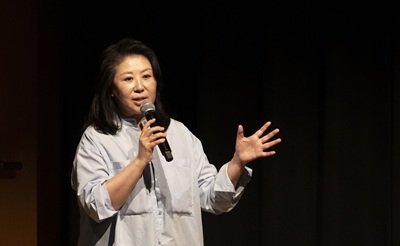
丹羽晴美(以下丹羽):ご来場いただき誠にありがとうございます。本日はニューヨーク近代美術館(MoMA)からロクサーナ・マルコチさんをお迎えし、スペシャルトークを開催いたします。当館は30周年を迎えますが、その計画段階でMoMAをリサーチし、展覧会やコレクション活動における独立性や理念を参考にさせていただきました。本日は、MoMAの現在のコレクションや、ロクサーナさんが手がけられた国際的に重要な展覧会についてお話を伺えるのをとても楽しみにしています。
ロクサーナ・マルコチ(以下マルコチ):こんにちは。本日はみなさんにお会いできて、大変に嬉しく、光栄に思います。
この場に招いていただけたことを、東京都写真美術館、そしてその主任学芸員である丹羽晴美さんに感謝申し上げます。また、30周年を記念する本展示にも心からの祝辞をお送りします。本展は私が長年敬愛してきた写真家たちの現在の活動を紹介するものです。中には、じかにお会いする機会を得た方もいました。
2019年10月、MoMAはコレクションギャラリーを新たに拡張して再オープンしました。そのコレクションは群島式のキュレーションモデルーーマルティニク出身の文化理論学者であり、詩人でもあったエドゥアール・グリッサンが世界的な文化の均質化に対抗して開発した、ポストコロニアルな文化融合モデルを採用しています。
II. MoMAコレクション展示の事例:写真の革新と批評性
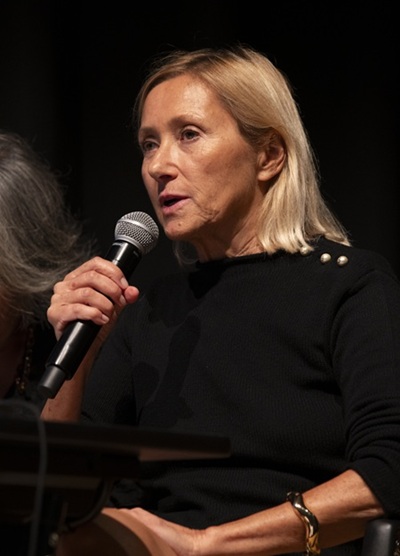
マルコチ:MoMAのコレクションは3層に分けられています。5階は1880~1940年代の歴史的展示を、4階は1940~1970年代の20世紀中期の展示を、そして2階は1980年代以降の現代的な展示を行うギャラリーとなっています。
リニューアル後、5階には写真と映像、つまり近代の視覚文化を作り替えた時間とレンズという新たなメディアに関する展示が加わりました。
そこでは、チャールズ・サーストン・トンプソンが1853年に制作した鏡の写真作品、その向かいの壁に映像の投影、さらにその隣には大手出版業者アンダーウッド&アンダーウッドによるステレオ写真、そしてマイブリッジによる動体記録連続写真を並べ、静止画から映像、科学からアートへと至る移行段階を視覚化しました。
1920~30年代の写真を主に扱ったエリアでは、「Machines, Mannequins, and Monsters(機械、マネキン、そして怪物たち)」というテーマを取り上げました。機械とマネキンと怪物は人体の代理物であり、シュールレアリスムにおける重要な比喩表現であり、万有機械論的なモチーフでもあります。当時、ショーウィンドーや雑誌の広告に登場するマネキンは日に日に人間味を帯び、写真家はその消費者の不気味な分身ともいうべき姿に惹かれていきました。例を挙げるなら、当時バウハウスの教授を務めていたヨゼフ・アルバースによる1930年代のフォトコラージュですね。あるいは、アルゼンチン出身の都市写真の先駆者オラシオ・コッポラによる、マネキンがファッションモデルのポーズをとったシュールレアリスムと社会主義リアリズムを融合した作品です。
5階の別エリアでは、生命を持つものと持たないものの境界線をぼかすような、シュールレアリスム的な歪みを持つ写真作品を置いています。たとえば1925年にメキシコで撮影されたエドワード・ウェストンの「Nude」、アンリ・カルティエ=ブレッソンの「Untitled」(1931)、頭のない二人の男を撮ったドラ・マールの「Man looking inside a sidewalk」(1935)、自身のシュールレアリスム期の最盛期にポータブルカメラの視点とグラフィックの構成で実験を重ねたリー・ミラー、ケルテスが布に包んでノートルダム大聖堂の裏の歩道に置き去りにした不思議な物体などです。
また、映画を中心としたエリアでは、1920~30年代の映画に登場した吸血鬼やゴーレム、せむし、その他の人間に似た姿をしている「怪物たち」のスチル写真を集めました。『ノスフェラトゥ』や『メトロポリス』といった作品は、当時浸透していた相違に対する差別と嫌悪、肉体の脆弱性と順応に対する恐怖を反映しており、人間であることについて問いかけるものでした。
4階に移りましょう。この階には、アーティストがカメラを路上へと持ち出した1960~70年代という時代の社会的・政治的激動の瞬間に注目したエリアがあります。ここで紹介される4名のアーティストはみなポータブルカメラを用い、独特な環境における日常の瞬間を捉えました。そのうちの一人が森山大道です。『provoke』の一員であり、粗く、無秩序な写真群を通して揺れ動く存在感を示し、ひいては大きく変化しつつあった日本の社会的、政治的動乱を表しました。1974年のジョン・シャーカフスキーによる「New Japanese Photography」展とまったく同じデザインを採用しているので、みなさんにぜひおすすめしたい展示となっています。
同階では、コンセプチュアルな写真作品やパフォーマティブな活動も紹介しています。ダン・グラハムは脱工業化した郊外の建築物と孤立した生活環境の関係性に注目し、コンセプチュアルアートへのアプローチを切り開きました。第二次大戦後のトラクト・ハウスを撮影した「Homes for America」(1966-7年)が写真家としての処女作です。プレハブ住宅と大衆向けテクノロジー、ポップカルチャーの語彙、ミニマリストの連続的構造を結びつけた、殺風景な建築様式に対する社会的分析となった一作です。
また、ドーラ・マウラーによる記号論的エアロビクス、あるいは自身の身体をアート的、社会的に柔軟な素材として探求したアナ・メンディエタのパフォーマンスならびにフェミニスト活動、肉体の開口部を並べて視覚的、構造的相似性を描き出し、文化的な枠組みを取り除いた上で鑑賞者が偏見にひきずられることなく感化できるキャロリー・シュニーマンの「Portrait Partials」などもここに展示されています。
ダン・グラハムに見られた郊外の社会構成と大量生産建築の関係性は、ベルント&ヒラ・ベッヒャーの作品からも伺えます。ベッヒャー夫妻は無名の工業建築の目録を作るという膨大な写真プロジェクトの作業中にその関係性に注目し、アート界ではなく、工業関係の出版物や、建築関係の雑誌にその知見を発表しました。
2階は現代の作品を取り扱うエリアとなっています。ここでまず登場するのは、ダラ・バーンバウムによる映像のインスタレーション、ルイーズ・ローラーやシンディ・シャーマンの写真など、力強い女性作家の作品です。
シャーマンの「Untitled Film Still」シリーズのように、1950~60年代の女性ヒロイン像を提示したことで彼女らは名声を得ました。それは、私たちがどこかで見たと思い込んでいる、ハリウッドのフィルム・ノワールやヨーロッパのアート映画に登場するヒロイン像です。さて、それではシャーマンはどうやってそれほどまでに影響力を持つ作品群を生むに至ったのでしょうか。
シャーマンは幼少期にとある映画を見て衝撃を受け、後年までその影響は見受けられます。その映画とは、ほとんど静止画によって構成され、動きのある映像はほんの一瞬しか使われないものでした。シャーマンは大人となり、その映画ーー関連性のないスチル画が物語を形作る、クリス・マルケルの『ラ・ジュテ』(1962年)と再会しました。
単発の静止画群から物語を作り出す技術に対する熱意はやがて、シャーマンの作品にて実を結びました。シャーマンは1950~70年代の他の著名な映画やディレクター、女優たちからインスピレーションを得て、映画に登場する女性たちのイメージを研究し、再構成したのです。
ダラ・バーンバウムによる映像インスタレーション作品《Technology/Transformation: Wonder Woman》は、人気作品『ワンダーウーマン』の素材を取り、再編集し、マスメディアが英雄化しつつも軽視した女性像を強調したものでした。
同階には、1990年代を中心としたエリアもあります。当時は文化戦争が巻き起こり、多くのアーティストが自身を、自身のコミュニティを、自身の物語を新たな形のポートレートとして表現し、自身のアイデンティティと存在を主張しました。写真と映像が組み合わさった日記体のアプローチが生まれ、時を越えた変化を捉えた作品が現れました。それはたとえばリン・ハーシュマン・リーソンの作品であり、リネケ・ダイクストラのタイムラプスシリーズ『Almerisa』であり、1990年代のヨーロッパのクラブとLGBTQ+社会運動と連動したアートにおいて重要な役割を果たしたヴォルフガング・ティルマンスの作品です。
III. キュレーションの新たな実践と展示空間の批評
マルコチ:次に、モノグラフ的ないくつかの展覧会について説明しましょう。これらは、インスタレーションデザインから出版物、オーディエンスの反応まで、キュレーションの原則について全体的に考え直すように人々を促しました。
クリストファー・ウィリアムスによる「The production line of Happiness」展(2014年)は、イメージ制作のコンテキストを拡張し、展示企画の組織性を問うものでした。当展示は従来の回顧展の形をとらず、3箇所の施設(シカゴ美術館、MoMA、そしてロンドンのホワイトチャペル・ギャラリー)のあいだの対話として徐々に形をなしていきました。各施設はそれぞれに色分けされたスーパーグラフィックスを用い、出版物にカバーをかぶせたのです。シカゴ美術館はコダック社の黄色、MoMAはAGFA社の赤、ホワイトチャペル・ギャラリーは富士フイルム社の緑です。
展示された作品群の中には、「Dix-Huit Leçons Sur La Société Industrielle」も含まれていました。これはフランスの社会学者レイモン・アロンが1962年に執筆した、フォーディズム的資本主義とソヴィエト型経済が主流だった冷戦時代の制作について論じた一作から名付けられた作品であり、写真そのものが作品の中心に据えられ、その機械や器具が登場します。分解されたカメラや今にもシャッターを切りそうなカメラ、写真のカラーチャートと合わせた笑顔のモデルたち、アナログな暗室、崇拝するかのように真新しい床面にぽつんと置かれた露出計。そうしたウィリアムスの写真群に一貫していたのは、制作というテーマでした。
その展覧会は慣例を無視し、美術館によって制定された高さよりも1フィート低く作品を設置しました。そうすることによって鑑賞にかけられる時間を引き伸ばしたのです。また、説明文も使用されていません。美術館によるラベルのかわりに、作品のコンテキストに関する情報を充実させたプログラムが配布されました。通常は壁に張り出されるキュレーションテキストもなく、入り口の壁には展示カタログの抜粋を掲げ、あたかも本からそのまま展覧会へと入り込むような仕掛けになっていました。その展覧会は、実際のところ、壁やイメージで展開されるエッセイだったのです。
「The production line of Happiness」展では、実験的な映像作品も紹介されました。出版物、映像作品と壁のインスタレーション作品、写真作品のすべてがウィリアムスによる写真の概念を際立たせ、「スペクタクルの社会」の草案、改訂、そして編成を示す一連の流れとなったのです。
IV. 最新の企画展:「What Is Parasite and What Is Kin?」
丹羽: ありがとうございます。ロクサーナさんの直近の展覧会をもう一つほどご紹介いただいて、その後、ディスカッションに移るのはいかがでしょうか。
マルコチ:逐次通訳のことも考えると、ご紹介しようと思った展覧会の話をすべてお伝えするには時間が足りないので、もう一件の展覧会のお話をしてから質疑応答に移りたいと思います。最近開催したばかりの展覧会についてお話しましょう。MoMAで行った1部屋のみの展覧会で、「What Is Parasite and What Is Kin(寄生か、同質か)」というタイトルでした。
本展は、紹介された4名のアーティストのひとりであるロータス・カンが言った、「何一つとして安定したものはない。体も、アイデンティティも」という言葉から名付けられました。
カンとその他3名のアーティストは、人間あるいは人間でないものの自我を、それらが過去と場に縛られながらもなお、順応性、美、技巧、精神性とテクノロジーと交わる様を描きました。寄生するものと共生するもののあいだに明確な線を引くことなく、相互的な関係性を示す作品群です。
ジャンルにとらわれないアーティストであるカンは、写真、スカルプチャー、インスタレーションといった分野を行き来し、場と空気に合わせて反応し、発展する可変的で不安定、流動的な素材を用い、儚さ、継承、記憶と時間という概念を作品にしています。
カンは光と湿気によって変化する工業サイズの写真フィルムを固定せずに使用することで、旧来のポートレートのフォーマットを作り替えました。そうした素材を肉体の表面になぞらえ、肌として定義し、絶え間ない変化を「日焼け」と呼んでいます。
ピエール・ユイグは「Mind’s Eye (L)」というスカルプチャー作品を提出しました。人間の視覚的想像力、人工知能、データと物質を具現化し、プラットフォーム上に据えた作品です。この作品を制作するにあたって、ユイグは複数の人々の脳を磁気共鳴機能画像法(fMRI)のスキャンにかけ、そのあいだに何かを考えてもらうよう頼みました。次に、そのデータを敵対的生成ネットワーク(GAN)のディープ・ラーニング・ソフトウェア・プログラムに読み込ませ、元のメンタルイメージを再現させました。私はこれを一種の写真としてみなしています。制作過程に、イメージを生成するというfMRIのプロセスが含まれているからです。
マメ・ディアラ・二アンは、抽象的な「非ポートレート」を制作しました。ニアンはあえて妨げとなるものを取り込むことで、西アフリカの古典的なスタジオ・ポートレートという分野を再構築したのです。黒人の身体は「外から投げかけられたあらゆる幽霊や神話や決まり文句」に取り憑かれていると言い、それを明確に表すことを避け、被写体をぼんやりとした幻のような形として組み立てました。
ウッドマウンテン・ハンクパパ・ラコタ族のアーティスト、ダナ・クラクストンによる「Headdress」シリーズからも何点か展示しています。3名の被写体をカラフルなビーズのアクセサリーで頭から腰まで飾り、彼女らが作ったか、そのコミュニティの女性から贈られた民族の正装を身につけさせ、正面から撮った作品です。
クラクストンの作品はLEDのライトボックスの中に設置されています。写真業界では「ホワイトボックス」という名称がありますが、クラクストンは「火災報知器」と呼んでいます。クラクストンはライトボックスの写真的性質を利用して女性たちの個性を隠し、鑑賞者たちの視線から守る盾として自身らの文化をまとわせました。先祖代々の伝統的工芸によって、共同体の主権によって、非生物的あるいは人工知能のまるで命を持ったかのような繊細さによって、彼女たちはそのコミュニティの文化を未来へと引き継ぐべく、忍耐強く主張し続けているのです。
現代のイメージ世界はデジタルなメタデータに占められる割合が増えつつあります。それらは高速なコンピューターで演算される機械的な視覚アルゴリズムによって管理され、アーティストや批評家、学者たちに新たな哲学的課題をもたらしました。世界を支配する物語に対して、どうすればウィットを持ってそれらを巧妙に打破し、問いただすことができるでしょうか? 当展示に登場したアーティストたちは、この世界を形づくる権力というシステムを、目に見えないデータを、経済的機構を、定着した偏見を検討し、分解するために写真を撮っています。時間と空間の両方の場で進化し続ける人間と機械の関係性において、そして今までになかった形の思考、アート、役割における写真の機能を理解することこそ、より公正で、相互的に形作られる、サステナブルな未来を描く鍵なのです。
V. 丹羽主任学芸員との対話:MoMAの構造と未来への展望
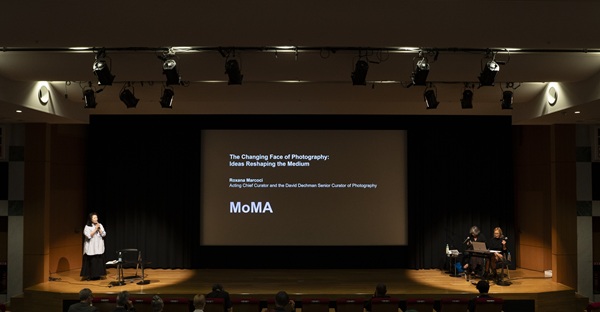
丹羽: まず、短い時間の発表の中に、ご準備いただいたトークをまとめていただき、心より感謝を申し上げたいと思います。
--コレクション構成とスタディコレクションの意義
丹羽:当初から、国際的に発信している重要な展覧会のお話と併せ、パーマネントコレクションを持つ当館でのトークということもあって、コレクションの話も入れてくださいとお願いしていました。
マルコチ:MoMAのコレクションはおよそ100年ほど前から存在し、現在は6つの部署へとキュレーションによって分けられています。各部署にそれぞれの委員会が存在し、年に数回、コレクションに新たな作品を迎え入れています。現時点では、30万点以上もの作品を収蔵しています。写真に関するコレクションですと、美術館側のコレクションにおよそ3万点、スタディコレクションには2万5千点ほどの作品があります。
美術館のコレクションに迎え入れるべき作品は理事、美術愛好家、コレクターが構成する委員会の投票によって決まります。スタディコレクションに関しては、投票は行われません。キュレーターがその研究目的に対して十分な意義を持つかどうか決定し、スタディコレクションに加えるか、美術館側のコレクションへ推薦します。
丹羽: 大変興味深いご説明ありがとうございます。この美術館には現在3万8千点を超えるコレクションがありますが、すべてがパーマネントコレクションで、おっしゃるようなキュレーターが決めて手放すこともできるスタディコレクションを持っていません。その考え方は今後の活動に参考になります。
--展覧会の未来と写真の拡張された領域
丹羽:ロクサーナさんの展覧会の組み方というのは、単なる美術館の中の展覧会ではなく、やはりその社会の構造、産業、工業といったものと非常に深く結びついていることを感じさせます。また、鑑賞者が自分の身体を使って、空間と作品と相互作用し、そこから意味を掴み取るための工夫がなされていると感じました。展覧会が美術館の中で終わってしまわないことというのを常に工夫していらっしゃるのではないかと想像します。今後のキュレーション計画の中で、展示室に収まらない社会と何か結びつく工夫の予定があれば教えていただければと思います。
マルコチ:私にとっての展覧会とはネットワークであり、創造的なプロセスです。アーティストは常に美術館の内側と外側の両方の空間を意識しており、社会的空間はその活動に不可欠なものなのです。彼らの作品は、それを受け取る側とはけっして切り離せません。展覧会へ来て、鑑賞し、美術館を出た後もその展示について話し合い、考え続ける大衆がいなければ成り立ちません。
私は、広大な分野としての写真に興味があります。オブジェとしての写真の物質性にも惹かれます。個々のプリントも、大規模な写真のインスタレーション作品も、どちらも美術館のために獲得したことがあります。たとえば、ラトーヤ・ルビー・フレイジャーによるコミッションの作品「The Last Cruze」は写真を用いた巨大なスカルプチャーインスタレーションです。
私たちはアーティストにとってのホームです。美術館はアーティストのホームなのです。私たちは、私たちがよく知っていることしかできません。それは、問いを、それも難しい問いを投げかける展覧会を作ること、そして、社会正義と人類の進化を信じている創造的な人々を信頼し、彼らの仕事を助け、支え続けることです。
丹羽: 日本の「写真」という漢字は「真実を写す」と書きます。これは発明された時からずっと問われてきたことですが、ロクサーナさんのキュレーションにも通じ、これから私たちが考え続けなければならないことだと感じました。本日は本当にありがとうございました。
TOP 30th Anniversary Talk Session
Roxana Marcoci Special Talk
Date:
October 9, 2025, 14:00-16:00
Speakers:
Roxana Marcoci(Curator of Museum of Modern Art, New York)
Niwa Harumi (Curator of Tokyo Photographic Art Museum, Moderator)
I. MoMA’s collection philosophy
Niwa Harumi (NH): Thank you for joining this special talk show. Today, we have invited Ms.Roxana Marcoci from The Museum of Modern Art, New York (MoMA). Tokyo Photographic Art Museum celebrates its 30th anniversary this year. During the preparatory phase before the establishment of the museum, we researched MoMA and studied its independence and ideologies on building exhibitions and collections. On this occasion, we are looking forward to hearing about the internationally acclaimed exhibitions she has curated and MoMA’s collection today.
Roxana Marcoci (RM): Good afternoon. It is a very great pleasure, a profound honor to be with you all today.
And so, I would like to express my gratitude in turn to the Tokyo Photographic Art Museum, and in particular to the Chief Curator, Niwa Harumi, for her very generous invitation and I extend my heartfelt congratulations on this 30th anniversary exhibition, which features the ongoing creative activities of photographers I have long admired, some who I had the opportunity and pleasure of meeting in the past.
In October 2019, the Museum of Modern Art reopened its doors with new and expanded collection galleries and an integrated collection which adopted a curatorial model based on the archipelago–a post-colonial model of composite cultures developed by Martinican cultural theorist and poet Édouard Glissant as a deliberate counterpoint to global homogeneity and cultural uniformity.
II. Examples from MoMA’s collection: the innovation and criticism of photography
RM: The collection at MoMA is organized around three floors, starting on the 5th floor with the historic period of the 1880s to the 1940s, a fourth floor of the mid-century period from the 1940s to the 1970s, and 2nd floor contemporary galleries which run from the 1980s to the present.
The 5th floor reopened with a presentation of photography and film–the new time-and-lens based mediums that reshaped the visual culture of the modern world.
Here you can see a series of photographs of mirrors made by Charles Thurston Thompson in 1853. On an opposite wall a film projection was on view next to a group of stereographs by the major publisher Underwood & Underwood and a series of chronophotographs by Muybridge accentuating the liminality of still and moving images, of science and art.
Another gallery predominantly showing photographs from the 1920s and ‘30s took on the theme of “Machines, Mannequins, and Monsters”. Surrogates of the human body, these three mechanomorphic figures were key Surrealist tropes. Photographers were particularly drawn to the increasingly lifelike mannequins that filled shop windows and magazine advertisings, uncanny doubles of the consumers, as in this 1930s photocollage by Joseph Albers, at the time professor at the Bauhaus. A different example is by the Argentinian pioneer of urban photography, Horacio Coppola, an image in which mannequins pose as fashion models, fusing the surreal with social realism.
Another wall in the installation offered a string of photographic works with a surrealist bend that blur the line between the animate and inanimate: Eadward Weston’s Nude, taken in Mexico in 1925; Henri-Cartier Bresson’s Untitled, c. 1931; Dora Maar’s Man looking inside a sidewalk of 1935, showing two male figures that are headless; Lee Miller, experimenting with mobile perspectives of the handheld camera and graphic compositions at the height of her Surrealist phase; and Kertesz’s enigmatic, sheet-shrouded bundles left sitting on the sidewalk behind Notre Dame cathedral.
Finally, another section focused on the silver screen, on film stills of vampires, golems, hunchbacks, and other anthropomorphic “monsters” culled from movies in the 1920s and ‘30s such as Nosferatu and Metropolis that reflected a pervasive racism and aversion to difference as well as the fears about the body’s vulnerability and malleability, raising questions about what it means to be human.
Moving to the 4th floor, one of the galleries highlighted a moment amid social and political turbulence around the world, when in the 1960s and 70s artists brought their cameras onto the streets. The four artists featured here all used handheld, portable cameras to capture the everyday theater of distinct environments: Daido Moriyama, a member of the Provoke group, for instance, engaged with often grainy and disorderly images reflecting a kind of existential disquiet and more broadly, the social and political upheavals of Japan during a time of profound societal transformation. The installation I just want to show you because it truly followed the same design as John Szarkowski's in New Japanese Photography exhibition of 1974.
Another gallery on the 4th floor was dedicated to conceptual photography and performative practices. Dan Graham opened an approach to conceptual practices by looking at the relationship between architecture and the alienating conditions of life, specifically in post-industrial suburbia. This is his first photographic work. Homes for America from 1966-67, a series of pictures of post–World War II tract houses, and his social analysis of prosaic architectural forms, which links prefab modular housing to Pop’s techno–mass culture lexicon and Minimalism’s serial structures.
Other examples included Dóra Maurer semiotic aerobics; the performative and feminist actions of Ana Mendieta's exploration of her body as a malleable art and social material; Carolee Schneemann's Portrait Partials depicting visual and structural similarities in an arrangement of bodily orifices, removing cultural frameworks and enabling viewers to relate without biases.
The connection between the social fabric of suburbia and mass-produced architecture that we saw in Dan Graham also caught the attention of Bernd and Hilla Becher, who were at work on a vast photographic project of cataloguing anonymous industrial architecture, which they first showed not in art institutions but in industrial publications and architectural journals.
Moving to the second floor contemporary galleries. It started with a very strong group of women artists: Dara Birnbaum with a video installation and with photographs by Louise Lawler and Cindy Sherman.
Now with regard to Sherman's Untitled Film Still series, they are so well known because it presents female heroines from the 1950s and 60s, Hollywood film noir and European art house films that we think we must have seen. The question remains how did Sherman arrive at making this influential body of work?
Early in her life, she had a revelatory experience viewing a film, which would leave an enduring impression on her. That movie was told entirely through still images, except for one brief moment of motion. As an adult, she re-encountered the film, which was Chris Marker's La Jetée (1962), a story constructed almost exclusively through single static shots.
This interest in the ability to create narrative through single images would come to fruition in this body of Sherman’s work, which takes inspiration from a number of other notable films, directors, and actresses from the 1950s to the ‘70s, while also challenging and reinventing the images of women seen in many of these films.
Finally, Dara Birnbaum's video installation Technology/Transformation: Wonder Woman was made by hijacking and reediting materials from the popular program “Wonder Woman” to emphasize how mass media alternates between heroic and trivializing depictions of women.
Another gallery was focused on the 1990s. As the culture wars raged, many artists turned to representing themselves, their communities, and their stories through alternative modes of portraiture, asserting their identities and presence. Photography and video were combined to allow for a diaristic approach, capturing change over time as in the case of Lynn Hershman Leeson. Also featured here were Rineke Dijkstra's time lapse series Almerisa, and Wolfgang Tillmans, who has played a critical role in several artistic contexts that were linked to the 1990s European clubs and the LGBTQ+ social movements.
III. New curatorial practices and criticism of the exhibition space
RM: Next I would like to discuss a series of monographic exhibitions which engage a comprehensive rethinking of curatorial tenets from installation design to publication and audience reception.
Christopher Williams, The production line of Happiness (2014), addressed the institutionality of exhibition making within the larger context of image production. Far from being a conventional retrospective, the show slowly emerged in dialogue between 3 institutions (the Art Institute of Chicago, MoMA, and Whitechapel, London), each venue identified by its own color-coded supergraphics and publication covers: at the AIC the color was Kodak yellow; at MoMA AGFA red; at Whitechapel Fuji green.
Among the bodies of work included was For Example: Dix-Huit Leçons Sur La Société Industrielle, which takes its title from the 1962 book by French sociologist Raymond Aron, a study of Cold War modes of production during Fordist capitalism and Soviet planned economy. The series put photography itself at its center, exposing the mechanical apparatus: sectioned cameras, cameras with a release shutter ready to be activated, smiling models matched with photographic color-charts, analogue darkrooms, and light meters isolated against pristine grounds like fetish objects. What tied Williams photographs together is the theme of production.
Unsettling museological conventions, the installation was installed about 1 foot lower than the institution’s statutory height, thus slowing down the process of looking, and it was also label free. Instead of museum labels, visitors had access to a program which included captions for the works with significant amounts of contextual information. Also eliminated were the canonical curatorial wall text in favor of excerpts called from the exhibition catalog straight onto the opening wall, as if the installation unfolded directly from the book. The show became an essay actually on walls and pictures.
The exhibition included a program of experimental films. The publication, the film program and the installation of walls and photographs underscored Williams’s idea of photography as a series of drafts and revisions and the formation of the Society of Spectacle.
IV. Latest special exhibition: What Is Parasite and What Is Kin?
NH: Thank you very much. May we hear about one more recent exhibition, and then move on to the discussion?
RM: It is obvious that we will not have sufficient time given the consecutive translation to cover all the other exhibitions I intended to present, so I will speak of one other installation and then we can move on to the Q&A with the audience. OK, then, why don't I go to the most recent one, an installation that I just opened. This is a one-room installation at MoMA, which is called What Is Parasite and What Is Kin?
The exhibition took its title from a quote by Lotus Kang, one of the four artists included in it, who said: “Nothing is in a fixed state, including the body and identity.”
Kang, and the other artists on view, describe forms of selfhood, both human and non-human, that are entangled with past and place, but also with resilience, beauty, craft, spirituality and technology. Without setting strict boundaries between the parasitic and symbiotic, their works point to interconnectedness.
A genre-defying artist, Lotus Kang works at the intersection of photography, sculpture and installation with changeable or unstable, volatile materials that are constantly developmental and respond to site and atmosphere, and works with ideas of impermanence, inheritance, memory and time.
Kang recasts the traditional portrait format by employing unfixed industrial size sheets of photographic film that change in response to light and humidity. Likening these materials to the surface of the body, the artist refers to them as skins, and terms their ongoing transformation “tanning.”
In the case of Pierre Huyghe, which is a sculpture titled Mind’s Eye (L) that you see on that platform, it is an embodiment of visual human imagination, artificial intelligence, data and matter. For this piece, the artist asked several people to think of something while their brains were being scanned by a functional magnetic resonance imaging (an fMRI). The data was then fed into a deep learning software program, a generic adversarial network or GAN that tried to reproduce the original mental picture. I also consider this to be a photograph because of the fMRI process that goes into the making of the work.
Mame-Diarra Niang creates abstract “non-portraits.” Here the artist deploys obstruction to deconstruct the genre of classical West African studio portraiture. Refusing to represent the black body, which she has described as being haunted by “all the ghosts and the myths and the cliches coming from the outside,” she composes her subject as blur, as oneiric forms.
Finally, the Wood Mountain Hunkpapa Lakota First Nation artist Dana Claxton is represented with a selection from her Headdress series, in which she introduces three sitters presented frontally and covered head-to-torso in their personal collection of colorful beaded jewelry and tribal regalia made or gifted to them by women in their communities.
The images are displayed in LED lightboxes, known in photography as “white boxes,” but in contrast, referred to by the artist as “fireboxes.” Claxton plays with the photographic nature of the lightbox, choosing to veil the identities of the women, allowing their culture to act as a shield from the viewers’ gazes. Whether drawing upon ancestral creative traditions, asserting collective sovereignty, or calling attention to the lifelike sensitivity of non-biological things and artificial intelligence, these selves resiliently insist to act as carriers of their communities’ culture into the future.
Our contemporary image-world–increasingly composed of digital metadata organized at vast computational speeds by machine vision algorithms–poses new philosophical questions for artists, critics, and scholars to ponder on. How can we question dominant narratives with wit and subtle subversion? The artists presented here are making photographs to evaluate and deconstruct the systems of power, unseen data, economic structures, and entrenched biases that shape the world. Understanding how photographic images function within ever evolving human and machine relationships in space and time—and therefore within new forms of thought, art, and agency—is key to imagining more equitable, mutually constitutive, and sustainable futures.
V. Discussion with Niwa: on MoMA’s structure and future outlook
NH: Thank you very much for summarizing the prepared subjects to fit the short time given for the presentation.
–On the composition of a collection and the value of a study collection
NH: We had requested Roxana to speak about the collection on top of the major international exhibitions, as TOP is also a museum with a permanent collection.
RM: The Museum of Modern Art has a collection which was started nearly 100 years ago and it involves six curatorial departments. Each one of these departments has their own committees and we acquire works for the collection several times a year. The collection currently includes over 300,000 works. The collection of photography itself includes about 30,000 works in the museum’s collection and another 25,000 in its study collection.
Works enter through a vote in the museum's collection. The vote comes from those committees which are composed of trustees, art lovers, and collectors. The study collection does not require a vote. The curators can decide that these works are sufficiently of interest for research purposes, and they can be kept in the study collection or they can be promoted into the museum’s collection.
NH: Thank you for the interesting clarification. Here, at TOP, we have a collection of over 38,000 pieces, all of which are included in the permanent collection. A study collection, as you say, where curators can decide to let go of works on their own, does not exist. Your insight will be helpful for our future activities.
–On the future of exhibitions and the expanded field of photography
NH: How you construct an exhibition seems to be more than just a project within the museum, but profoundly tied to its social structure, industry, and manufacturing. I can also see how you allow the viewers to interact with the space and the work to display their significance using their own bodies. I imagine that you are continuously working so that the exhibition does not solely end in the museum. For your curatorial projects in the future, do you have any plans for initiatives to take the exhibition beyond the confines of its walls, linking it to society?
RM: An exhibition to me is a network, it's a creative process. Artists always consider space both inside the museum and outside it, that social space as being integral to their practice. Their work only exists in relation to reception, in relation to the public who comes and visits an exhibition, who continues to talk and think about the exhibition long after they leave the museum.
I am interested in photography in an expanded field. I also like the materiality of the photograph as an object. I acquired for the museum both individual prints and very large-scale photographic installations. I acquired, for instance, commissions like LaToya Ruby Frazier’s The Last Cruze, which is an enormous sculpture and photographic installation.
We are a house for the artists. Museums are houses for artists. And we can only do what we know how to do best–that is, exhibitions that pose questions, difficult questions, and that continue to support and buttress the work of those who we believe in... creative people who believe in social justice and the advancement of humanity.
NH: In Japanese, “photography (写真)” means to “transcribe the truth (真実を写す)”. This notion has been questioned since its time of invention, and through your curations, I felt that we must continue to keep reflecting on this question. Thank you very much for your time today.
ロクサーナ・マルコチ氏 スペシャルトーク
日 時:
2025年10月9日(木)14:00-16:00
登壇者:
ロクサーナ・マルコチ(ニューヨーク近代美術館 キュレーター)
丹羽 晴美(東京都写真美術館 主任学芸員)
I. MoMAのコレクション哲学
丹羽晴美(以下丹羽):ご来場いただき誠にありがとうございます。本日はニューヨーク近代美術館(MoMA)からロクサーナ・マルコチさんをお迎えし、スペシャルトークを開催いたします。当館は30周年を迎えますが、その計画段階でMoMAをリサーチし、展覧会やコレクション活動における独立性や理念を参考にさせていただきました。本日は、MoMAの現在のコレクションや、ロクサーナさんが手がけられた国際的に重要な展覧会についてお話を伺えるのをとても楽しみにしています。
ロクサーナ・マルコチ(以下マルコチ):こんにちは。本日はみなさんにお会いできて、大変に嬉しく、光栄に思います。
この場に招いていただけたことを、東京都写真美術館、そしてその主任学芸員である丹羽晴美さんに感謝申し上げます。また、30周年を記念する本展示にも心からの祝辞をお送りします。本展は私が長年敬愛してきた写真家たちの現在の活動を紹介するものです。中には、じかにお会いする機会を得た方もいました。
2019年10月、MoMAはコレクションギャラリーを新たに拡張して再オープンしました。そのコレクションは群島式のキュレーションモデルーーマルティニク出身の文化理論学者であり、詩人でもあったエドゥアール・グリッサンが世界的な文化の均質化に対抗して開発した、ポストコロニアルな文化融合モデルを採用しています。
II. MoMAコレクション展示の事例:写真の革新と批評性
マルコチ:MoMAのコレクションは3層に分けられています。5階は1880~1940年代の歴史的展示を、4階は1940~1970年代の20世紀中期の展示を、そして2階は1980年代以降の現代的な展示を行うギャラリーとなっています。
リニューアル後、5階には写真と映像、つまり近代の視覚文化を作り替えた時間とレンズという新たなメディアに関する展示が加わりました。
そこでは、チャールズ・サーストン・トンプソンが1853年に制作した鏡の写真作品、その向かいの壁に映像の投影、さらにその隣には大手出版業者アンダーウッド&アンダーウッドによるステレオ写真、そしてマイブリッジによる動体記録連続写真を並べ、静止画から映像、科学からアートへと至る移行段階を視覚化しました。
1920~30年代の写真を主に扱ったエリアでは、「Machines, Mannequins, and Monsters(機械、マネキン、そして怪物たち)」というテーマを取り上げました。機械とマネキンと怪物は人体の代理物であり、シュールレアリスムにおける重要な比喩表現であり、万有機械論的なモチーフでもあります。当時、ショーウィンドーや雑誌の広告に登場するマネキンは日に日に人間味を帯び、写真家はその消費者の不気味な分身ともいうべき姿に惹かれていきました。例を挙げるなら、当時バウハウスの教授を務めていたヨゼフ・アルバースによる1930年代のフォトコラージュですね。あるいは、アルゼンチン出身の都市写真の先駆者オラシオ・コッポラによる、マネキンがファッションモデルのポーズをとったシュールレアリスムと社会主義リアリズムを融合した作品です。
5階の別エリアでは、生命を持つものと持たないものの境界線をぼかすような、シュールレアリスム的な歪みを持つ写真作品を置いています。たとえば1925年にメキシコで撮影されたエドワード・ウェストンの「Nude」、アンリ・カルティエ=ブレッソンの「Untitled」(1931)、頭のない二人の男を撮ったドラ・マールの「Man looking inside a sidewalk」(1935)、自身のシュールレアリスム期の最盛期にポータブルカメラの視点とグラフィックの構成で実験を重ねたリー・ミラー、ケルテスが布に包んでノートルダム大聖堂の裏の歩道に置き去りにした不思議な物体などです。
また、映画を中心としたエリアでは、1920~30年代の映画に登場した吸血鬼やゴーレム、せむし、その他の人間に似た姿をしている「怪物たち」のスチル写真を集めました。『ノスフェラトゥ』や『メトロポリス』といった作品は、当時浸透していた相違に対する差別と嫌悪、肉体の脆弱性と順応に対する恐怖を反映しており、人間であることについて問いかけるものでした。
4階に移りましょう。この階には、アーティストがカメラを路上へと持ち出した1960~70年代という時代の社会的・政治的激動の瞬間に注目したエリアがあります。ここで紹介される4名のアーティストはみなポータブルカメラを用い、独特な環境における日常の瞬間を捉えました。そのうちの一人が森山大道です。『provoke』の一員であり、粗く、無秩序な写真群を通して揺れ動く存在感を示し、ひいては大きく変化しつつあった日本の社会的、政治的動乱を表しました。1974年のジョン・シャーカフスキーによる「New Japanese Photography」展とまったく同じデザインを採用しているので、みなさんにぜひおすすめしたい展示となっています。
同階では、コンセプチュアルな写真作品やパフォーマティブな活動も紹介しています。ダン・グラハムは脱工業化した郊外の建築物と孤立した生活環境の関係性に注目し、コンセプチュアルアートへのアプローチを切り開きました。第二次大戦後のトラクト・ハウスを撮影した「Homes for America」(1966-7年)が写真家としての処女作です。プレハブ住宅と大衆向けテクノロジー、ポップカルチャーの語彙、ミニマリストの連続的構造を結びつけた、殺風景な建築様式に対する社会的分析となった一作です。
また、ドーラ・マウラーによる記号論的エアロビクス、あるいは自身の身体をアート的、社会的に柔軟な素材として探求したアナ・メンディエタのパフォーマンスならびにフェミニスト活動、肉体の開口部を並べて視覚的、構造的相似性を描き出し、文化的な枠組みを取り除いた上で鑑賞者が偏見にひきずられることなく感化できるキャロリー・シュニーマンの「Portrait Partials」などもここに展示されています。
ダン・グラハムに見られた郊外の社会構成と大量生産建築の関係性は、ベルント&ヒラ・ベッヒャーの作品からも伺えます。ベッヒャー夫妻は無名の工業建築の目録を作るという膨大な写真プロジェクトの作業中にその関係性に注目し、アート界ではなく、工業関係の出版物や、建築関係の雑誌にその知見を発表しました。
2階は現代の作品を取り扱うエリアとなっています。ここでまず登場するのは、ダラ・バーンバウムによる映像のインスタレーション、ルイーズ・ローラーやシンディ・シャーマンの写真など、力強い女性作家の作品です。
シャーマンの「Untitled Film Still」シリーズのように、1950~60年代の女性ヒロイン像を提示したことで彼女らは名声を得ました。それは、私たちがどこかで見たと思い込んでいる、ハリウッドのフィルム・ノワールやヨーロッパのアート映画に登場するヒロイン像です。さて、それではシャーマンはどうやってそれほどまでに影響力を持つ作品群を生むに至ったのでしょうか。
シャーマンは幼少期にとある映画を見て衝撃を受け、後年までその影響は見受けられます。その映画とは、ほとんど静止画によって構成され、動きのある映像はほんの一瞬しか使われないものでした。シャーマンは大人となり、その映画ーー関連性のないスチル画が物語を形作る、クリス・マルケルの『ラ・ジュテ』(1962年)と再会しました。
単発の静止画群から物語を作り出す技術に対する熱意はやがて、シャーマンの作品にて実を結びました。シャーマンは1950~70年代の他の著名な映画やディレクター、女優たちからインスピレーションを得て、映画に登場する女性たちのイメージを研究し、再構成したのです。
ダラ・バーンバウムによる映像インスタレーション作品《Technology/Transformation: Wonder Woman》は、人気作品『ワンダーウーマン』の素材を取り、再編集し、マスメディアが英雄化しつつも軽視した女性像を強調したものでした。
同階には、1990年代を中心としたエリアもあります。当時は文化戦争が巻き起こり、多くのアーティストが自身を、自身のコミュニティを、自身の物語を新たな形のポートレートとして表現し、自身のアイデンティティと存在を主張しました。写真と映像が組み合わさった日記体のアプローチが生まれ、時を越えた変化を捉えた作品が現れました。それはたとえばリン・ハーシュマン・リーソンの作品であり、リネケ・ダイクストラのタイムラプスシリーズ『Almerisa』であり、1990年代のヨーロッパのクラブとLGBTQ+社会運動と連動したアートにおいて重要な役割を果たしたヴォルフガング・ティルマンスの作品です。
III. キュレーションの新たな実践と展示空間の批評
マルコチ:次に、モノグラフ的ないくつかの展覧会について説明しましょう。これらは、インスタレーションデザインから出版物、オーディエンスの反応まで、キュレーションの原則について全体的に考え直すように人々を促しました。
クリストファー・ウィリアムスによる「The production line of Happiness」展(2014年)は、イメージ制作のコンテキストを拡張し、展示企画の組織性を問うものでした。当展示は従来の回顧展の形をとらず、3箇所の施設(シカゴ美術館、MoMA、そしてロンドンのホワイトチャペル・ギャラリー)のあいだの対話として徐々に形をなしていきました。各施設はそれぞれに色分けされたスーパーグラフィックスを用い、出版物にカバーをかぶせたのです。シカゴ美術館はコダック社の黄色、MoMAはAGFA社の赤、ホワイトチャペル・ギャラリーは富士フイルム社の緑です。
展示された作品群の中には、「Dix-Huit Leçons Sur La Société Industrielle」も含まれていました。これはフランスの社会学者レイモン・アロンが1962年に執筆した、フォーディズム的資本主義とソヴィエト型経済が主流だった冷戦時代の制作について論じた一作から名付けられた作品であり、写真そのものが作品の中心に据えられ、その機械や器具が登場します。分解されたカメラや今にもシャッターを切りそうなカメラ、写真のカラーチャートと合わせた笑顔のモデルたち、アナログな暗室、崇拝するかのように真新しい床面にぽつんと置かれた露出計。そうしたウィリアムスの写真群に一貫していたのは、制作というテーマでした。
その展覧会は慣例を無視し、美術館によって制定された高さよりも1フィート低く作品を設置しました。そうすることによって鑑賞にかけられる時間を引き伸ばしたのです。また、説明文も使用されていません。美術館によるラベルのかわりに、作品のコンテキストに関する情報を充実させたプログラムが配布されました。通常は壁に張り出されるキュレーションテキストもなく、入り口の壁には展示カタログの抜粋を掲げ、あたかも本からそのまま展覧会へと入り込むような仕掛けになっていました。その展覧会は、実際のところ、壁やイメージで展開されるエッセイだったのです。
「The production line of Happiness」展では、実験的な映像作品も紹介されました。出版物、映像作品と壁のインスタレーション作品、写真作品のすべてがウィリアムスによる写真の概念を際立たせ、「スペクタクルの社会」の草案、改訂、そして編成を示す一連の流れとなったのです。
IV. 最新の企画展:「What Is Parasite and What Is Kin?」
丹羽: ありがとうございます。ロクサーナさんの直近の展覧会をもう一つほどご紹介いただいて、その後、ディスカッションに移るのはいかがでしょうか。
マルコチ:逐次通訳のことも考えると、ご紹介しようと思った展覧会の話をすべてお伝えするには時間が足りないので、もう一件の展覧会のお話をしてから質疑応答に移りたいと思います。最近開催したばかりの展覧会についてお話しましょう。MoMAで行った1部屋のみの展覧会で、「What Is Parasite and What Is Kin(寄生か、同質か)」というタイトルでした。
本展は、紹介された4名のアーティストのひとりであるロータス・カンが言った、「何一つとして安定したものはない。体も、アイデンティティも」という言葉から名付けられました。
カンとその他3名のアーティストは、人間あるいは人間でないものの自我を、それらが過去と場に縛られながらもなお、順応性、美、技巧、精神性とテクノロジーと交わる様を描きました。寄生するものと共生するもののあいだに明確な線を引くことなく、相互的な関係性を示す作品群です。
ジャンルにとらわれないアーティストであるカンは、写真、スカルプチャー、インスタレーションといった分野を行き来し、場と空気に合わせて反応し、発展する可変的で不安定、流動的な素材を用い、儚さ、継承、記憶と時間という概念を作品にしています。
カンは光と湿気によって変化する工業サイズの写真フィルムを固定せずに使用することで、旧来のポートレートのフォーマットを作り替えました。そうした素材を肉体の表面になぞらえ、肌として定義し、絶え間ない変化を「日焼け」と呼んでいます。
ピエール・ユイグは「Mind’s Eye (L)」というスカルプチャー作品を提出しました。人間の視覚的想像力、人工知能、データと物質を具現化し、プラットフォーム上に据えた作品です。この作品を制作するにあたって、ユイグは複数の人々の脳を磁気共鳴機能画像法(fMRI)のスキャンにかけ、そのあいだに何かを考えてもらうよう頼みました。次に、そのデータを敵対的生成ネットワーク(GAN)のディープ・ラーニング・ソフトウェア・プログラムに読み込ませ、元のメンタルイメージを再現させました。私はこれを一種の写真としてみなしています。制作過程に、イメージを生成するというfMRIのプロセスが含まれているからです。
マメ・ディアラ・二アンは、抽象的な「非ポートレート」を制作しました。ニアンはあえて妨げとなるものを取り込むことで、西アフリカの古典的なスタジオ・ポートレートという分野を再構築したのです。黒人の身体は「外から投げかけられたあらゆる幽霊や神話や決まり文句」に取り憑かれていると言い、それを明確に表すことを避け、被写体をぼんやりとした幻のような形として組み立てました。
ウッドマウンテン・ハンクパパ・ラコタ族のアーティスト、ダナ・クラクストンによる「Headdress」シリーズからも何点か展示しています。3名の被写体をカラフルなビーズのアクセサリーで頭から腰まで飾り、彼女らが作ったか、そのコミュニティの女性から贈られた民族の正装を身につけさせ、正面から撮った作品です。
クラクストンの作品はLEDのライトボックスの中に設置されています。写真業界では「ホワイトボックス」という名称がありますが、クラクストンは「火災報知器」と呼んでいます。クラクストンはライトボックスの写真的性質を利用して女性たちの個性を隠し、鑑賞者たちの視線から守る盾として自身らの文化をまとわせました。先祖代々の伝統的工芸によって、共同体の主権によって、非生物的あるいは人工知能のまるで命を持ったかのような繊細さによって、彼女たちはそのコミュニティの文化を未来へと引き継ぐべく、忍耐強く主張し続けているのです。
現代のイメージ世界はデジタルなメタデータに占められる割合が増えつつあります。それらは高速なコンピューターで演算される機械的な視覚アルゴリズムによって管理され、アーティストや批評家、学者たちに新たな哲学的課題をもたらしました。世界を支配する物語に対して、どうすればウィットを持ってそれらを巧妙に打破し、問いただすことができるでしょうか? 当展示に登場したアーティストたちは、この世界を形づくる権力というシステムを、目に見えないデータを、経済的機構を、定着した偏見を検討し、分解するために写真を撮っています。時間と空間の両方の場で進化し続ける人間と機械の関係性において、そして今までになかった形の思考、アート、役割における写真の機能を理解することこそ、より公正で、相互的に形作られる、サステナブルな未来を描く鍵なのです。
V. 丹羽主任学芸員との対話:MoMAの構造と未来への展望
丹羽: まず、短い時間の発表の中に、ご準備いただいたトークをまとめていただき、心より感謝を申し上げたいと思います。
--コレクション構成とスタディコレクションの意義
丹羽:当初から、国際的に発信している重要な展覧会のお話と併せ、パーマネントコレクションを持つ当館でのトークということもあって、コレクションの話も入れてくださいとお願いしていました。
マルコチ:MoMAのコレクションはおよそ100年ほど前から存在し、現在は6つの部署へとキュレーションによって分けられています。各部署にそれぞれの委員会が存在し、年に数回、コレクションに新たな作品を迎え入れています。現時点では、30万点以上もの作品を収蔵しています。写真に関するコレクションですと、美術館側のコレクションにおよそ3万点、スタディコレクションには2万5千点ほどの作品があります。
美術館のコレクションに迎え入れるべき作品は理事、美術愛好家、コレクターが構成する委員会の投票によって決まります。スタディコレクションに関しては、投票は行われません。キュレーターがその研究目的に対して十分な意義を持つかどうか決定し、スタディコレクションに加えるか、美術館側のコレクションへ推薦します。
丹羽: 大変興味深いご説明ありがとうございます。この美術館には現在3万8千点を超えるコレクションがありますが、すべてがパーマネントコレクションで、おっしゃるようなキュレーターが決めて手放すこともできるスタディコレクションを持っていません。その考え方は今後の活動に参考になります。
--展覧会の未来と写真の拡張された領域
丹羽:ロクサーナさんの展覧会の組み方というのは、単なる美術館の中の展覧会ではなく、やはりその社会の構造、産業、工業といったものと非常に深く結びついていることを感じさせます。また、鑑賞者が自分の身体を使って、空間と作品と相互作用し、そこから意味を掴み取るための工夫がなされていると感じました。展覧会が美術館の中で終わってしまわないことというのを常に工夫していらっしゃるのではないかと想像します。今後のキュレーション計画の中で、展示室に収まらない社会と何か結びつく工夫の予定があれば教えていただければと思います。
マルコチ:私にとっての展覧会とはネットワークであり、創造的なプロセスです。アーティストは常に美術館の内側と外側の両方の空間を意識しており、社会的空間はその活動に不可欠なものなのです。彼らの作品は、それを受け取る側とはけっして切り離せません。展覧会へ来て、鑑賞し、美術館を出た後もその展示について話し合い、考え続ける大衆がいなければ成り立ちません。
私は、広大な分野としての写真に興味があります。オブジェとしての写真の物質性にも惹かれます。個々のプリントも、大規模な写真のインスタレーション作品も、どちらも美術館のために獲得したことがあります。たとえば、ラトーヤ・ルビー・フレイジャーによるコミッションの作品「The Last Cruze」は写真を用いた巨大なスカルプチャーインスタレーションです。
私たちはアーティストにとってのホームです。美術館はアーティストのホームなのです。私たちは、私たちがよく知っていることしかできません。それは、問いを、それも難しい問いを投げかける展覧会を作ること、そして、社会正義と人類の進化を信じている創造的な人々を信頼し、彼らの仕事を助け、支え続けることです。
丹羽: 日本の「写真」という漢字は「真実を写す」と書きます。これは発明された時からずっと問われてきたことですが、ロクサーナさんのキュレーションにも通じ、これから私たちが考え続けなければならないことだと感じました。本日は本当にありがとうございました。
TOP 30th Anniversary Talk Session
Roxana Marcoci Special Talk
Date:
October 9, 2025, 14:00-16:00
Speakers:
Roxana Marcoci(Curator of Museum of Modern Art, New York)
Niwa Harumi (Curator of Tokyo Photographic Art Museum, Moderator)
I. MoMA’s collection philosophy
Niwa Harumi (NH): Thank you for joining this special talk show. Today, we have invited Ms.Roxana Marcoci from The Museum of Modern Art, New York (MoMA). Tokyo Photographic Art Museum celebrates its 30th anniversary this year. During the preparatory phase before the establishment of the museum, we researched MoMA and studied its independence and ideologies on building exhibitions and collections. On this occasion, we are looking forward to hearing about the internationally acclaimed exhibitions she has curated and MoMA’s collection today.
Roxana Marcoci (RM): Good afternoon. It is a very great pleasure, a profound honor to be with you all today.
And so, I would like to express my gratitude in turn to the Tokyo Photographic Art Museum, and in particular to the Chief Curator, Niwa Harumi, for her very generous invitation and I extend my heartfelt congratulations on this 30th anniversary exhibition, which features the ongoing creative activities of photographers I have long admired, some who I had the opportunity and pleasure of meeting in the past.
In October 2019, the Museum of Modern Art reopened its doors with new and expanded collection galleries and an integrated collection which adopted a curatorial model based on the archipelago–a post-colonial model of composite cultures developed by Martinican cultural theorist and poet Édouard Glissant as a deliberate counterpoint to global homogeneity and cultural uniformity.
II. Examples from MoMA’s collection: the innovation and criticism of photography
RM: The collection at MoMA is organized around three floors, starting on the 5th floor with the historic period of the 1880s to the 1940s, a fourth floor of the mid-century period from the 1940s to the 1970s, and 2nd floor contemporary galleries which run from the 1980s to the present.
The 5th floor reopened with a presentation of photography and film–the new time-and-lens based mediums that reshaped the visual culture of the modern world.
Here you can see a series of photographs of mirrors made by Charles Thurston Thompson in 1853. On an opposite wall a film projection was on view next to a group of stereographs by the major publisher Underwood & Underwood and a series of chronophotographs by Muybridge accentuating the liminality of still and moving images, of science and art.
Another gallery predominantly showing photographs from the 1920s and ‘30s took on the theme of “Machines, Mannequins, and Monsters”. Surrogates of the human body, these three mechanomorphic figures were key Surrealist tropes. Photographers were particularly drawn to the increasingly lifelike mannequins that filled shop windows and magazine advertisings, uncanny doubles of the consumers, as in this 1930s photocollage by Joseph Albers, at the time professor at the Bauhaus. A different example is by the Argentinian pioneer of urban photography, Horacio Coppola, an image in which mannequins pose as fashion models, fusing the surreal with social realism.
Another wall in the installation offered a string of photographic works with a surrealist bend that blur the line between the animate and inanimate: Eadward Weston’s Nude, taken in Mexico in 1925; Henri-Cartier Bresson’s Untitled, c. 1931; Dora Maar’s Man looking inside a sidewalk of 1935, showing two male figures that are headless; Lee Miller, experimenting with mobile perspectives of the handheld camera and graphic compositions at the height of her Surrealist phase; and Kertesz’s enigmatic, sheet-shrouded bundles left sitting on the sidewalk behind Notre Dame cathedral.
Finally, another section focused on the silver screen, on film stills of vampires, golems, hunchbacks, and other anthropomorphic “monsters” culled from movies in the 1920s and ‘30s such as Nosferatu and Metropolis that reflected a pervasive racism and aversion to difference as well as the fears about the body’s vulnerability and malleability, raising questions about what it means to be human.
Moving to the 4th floor, one of the galleries highlighted a moment amid social and political turbulence around the world, when in the 1960s and 70s artists brought their cameras onto the streets. The four artists featured here all used handheld, portable cameras to capture the everyday theater of distinct environments: Daido Moriyama, a member of the Provoke group, for instance, engaged with often grainy and disorderly images reflecting a kind of existential disquiet and more broadly, the social and political upheavals of Japan during a time of profound societal transformation. The installation I just want to show you because it truly followed the same design as John Szarkowski's in New Japanese Photography exhibition of 1974.
Another gallery on the 4th floor was dedicated to conceptual photography and performative practices. Dan Graham opened an approach to conceptual practices by looking at the relationship between architecture and the alienating conditions of life, specifically in post-industrial suburbia. This is his first photographic work. Homes for America from 1966-67, a series of pictures of post–World War II tract houses, and his social analysis of prosaic architectural forms, which links prefab modular housing to Pop’s techno–mass culture lexicon and Minimalism’s serial structures.
Other examples included Dóra Maurer semiotic aerobics; the performative and feminist actions of Ana Mendieta's exploration of her body as a malleable art and social material; Carolee Schneemann's Portrait Partials depicting visual and structural similarities in an arrangement of bodily orifices, removing cultural frameworks and enabling viewers to relate without biases.
The connection between the social fabric of suburbia and mass-produced architecture that we saw in Dan Graham also caught the attention of Bernd and Hilla Becher, who were at work on a vast photographic project of cataloguing anonymous industrial architecture, which they first showed not in art institutions but in industrial publications and architectural journals.
Moving to the second floor contemporary galleries. It started with a very strong group of women artists: Dara Birnbaum with a video installation and with photographs by Louise Lawler and Cindy Sherman.
Now with regard to Sherman's Untitled Film Still series, they are so well known because it presents female heroines from the 1950s and 60s, Hollywood film noir and European art house films that we think we must have seen. The question remains how did Sherman arrive at making this influential body of work?
Early in her life, she had a revelatory experience viewing a film, which would leave an enduring impression on her. That movie was told entirely through still images, except for one brief moment of motion. As an adult, she re-encountered the film, which was Chris Marker's La Jetée (1962), a story constructed almost exclusively through single static shots.
This interest in the ability to create narrative through single images would come to fruition in this body of Sherman’s work, which takes inspiration from a number of other notable films, directors, and actresses from the 1950s to the ‘70s, while also challenging and reinventing the images of women seen in many of these films.
Finally, Dara Birnbaum's video installation Technology/Transformation: Wonder Woman was made by hijacking and reediting materials from the popular program “Wonder Woman” to emphasize how mass media alternates between heroic and trivializing depictions of women.
Another gallery was focused on the 1990s. As the culture wars raged, many artists turned to representing themselves, their communities, and their stories through alternative modes of portraiture, asserting their identities and presence. Photography and video were combined to allow for a diaristic approach, capturing change over time as in the case of Lynn Hershman Leeson. Also featured here were Rineke Dijkstra's time lapse series Almerisa, and Wolfgang Tillmans, who has played a critical role in several artistic contexts that were linked to the 1990s European clubs and the LGBTQ+ social movements.
III. New curatorial practices and criticism of the exhibition space
RM: Next I would like to discuss a series of monographic exhibitions which engage a comprehensive rethinking of curatorial tenets from installation design to publication and audience reception.
Christopher Williams, The production line of Happiness (2014), addressed the institutionality of exhibition making within the larger context of image production. Far from being a conventional retrospective, the show slowly emerged in dialogue between 3 institutions (the Art Institute of Chicago, MoMA, and Whitechapel, London), each venue identified by its own color-coded supergraphics and publication covers: at the AIC the color was Kodak yellow; at MoMA AGFA red; at Whitechapel Fuji green.
Among the bodies of work included was For Example: Dix-Huit Leçons Sur La Société Industrielle, which takes its title from the 1962 book by French sociologist Raymond Aron, a study of Cold War modes of production during Fordist capitalism and Soviet planned economy. The series put photography itself at its center, exposing the mechanical apparatus: sectioned cameras, cameras with a release shutter ready to be activated, smiling models matched with photographic color-charts, analogue darkrooms, and light meters isolated against pristine grounds like fetish objects. What tied Williams photographs together is the theme of production.
Unsettling museological conventions, the installation was installed about 1 foot lower than the institution’s statutory height, thus slowing down the process of looking, and it was also label free. Instead of museum labels, visitors had access to a program which included captions for the works with significant amounts of contextual information. Also eliminated were the canonical curatorial wall text in favor of excerpts called from the exhibition catalog straight onto the opening wall, as if the installation unfolded directly from the book. The show became an essay actually on walls and pictures.
The exhibition included a program of experimental films. The publication, the film program and the installation of walls and photographs underscored Williams’s idea of photography as a series of drafts and revisions and the formation of the Society of Spectacle.
IV. Latest special exhibition: What Is Parasite and What Is Kin?
NH: Thank you very much. May we hear about one more recent exhibition, and then move on to the discussion?
RM: It is obvious that we will not have sufficient time given the consecutive translation to cover all the other exhibitions I intended to present, so I will speak of one other installation and then we can move on to the Q&A with the audience. OK, then, why don't I go to the most recent one, an installation that I just opened. This is a one-room installation at MoMA, which is called What Is Parasite and What Is Kin?
The exhibition took its title from a quote by Lotus Kang, one of the four artists included in it, who said: “Nothing is in a fixed state, including the body and identity.”
Kang, and the other artists on view, describe forms of selfhood, both human and non-human, that are entangled with past and place, but also with resilience, beauty, craft, spirituality and technology. Without setting strict boundaries between the parasitic and symbiotic, their works point to interconnectedness.
A genre-defying artist, Lotus Kang works at the intersection of photography, sculpture and installation with changeable or unstable, volatile materials that are constantly developmental and respond to site and atmosphere, and works with ideas of impermanence, inheritance, memory and time.
Kang recasts the traditional portrait format by employing unfixed industrial size sheets of photographic film that change in response to light and humidity. Likening these materials to the surface of the body, the artist refers to them as skins, and terms their ongoing transformation “tanning.”
In the case of Pierre Huyghe, which is a sculpture titled Mind’s Eye (L) that you see on that platform, it is an embodiment of visual human imagination, artificial intelligence, data and matter. For this piece, the artist asked several people to think of something while their brains were being scanned by a functional magnetic resonance imaging (an fMRI). The data was then fed into a deep learning software program, a generic adversarial network or GAN that tried to reproduce the original mental picture. I also consider this to be a photograph because of the fMRI process that goes into the making of the work.
Mame-Diarra Niang creates abstract “non-portraits.” Here the artist deploys obstruction to deconstruct the genre of classical West African studio portraiture. Refusing to represent the black body, which she has described as being haunted by “all the ghosts and the myths and the cliches coming from the outside,” she composes her subject as blur, as oneiric forms.
Finally, the Wood Mountain Hunkpapa Lakota First Nation artist Dana Claxton is represented with a selection from her Headdress series, in which she introduces three sitters presented frontally and covered head-to-torso in their personal collection of colorful beaded jewelry and tribal regalia made or gifted to them by women in their communities.
The images are displayed in LED lightboxes, known in photography as “white boxes,” but in contrast, referred to by the artist as “fireboxes.” Claxton plays with the photographic nature of the lightbox, choosing to veil the identities of the women, allowing their culture to act as a shield from the viewers’ gazes. Whether drawing upon ancestral creative traditions, asserting collective sovereignty, or calling attention to the lifelike sensitivity of non-biological things and artificial intelligence, these selves resiliently insist to act as carriers of their communities’ culture into the future.
Our contemporary image-world–increasingly composed of digital metadata organized at vast computational speeds by machine vision algorithms–poses new philosophical questions for artists, critics, and scholars to ponder on. How can we question dominant narratives with wit and subtle subversion? The artists presented here are making photographs to evaluate and deconstruct the systems of power, unseen data, economic structures, and entrenched biases that shape the world. Understanding how photographic images function within ever evolving human and machine relationships in space and time—and therefore within new forms of thought, art, and agency—is key to imagining more equitable, mutually constitutive, and sustainable futures.
V. Discussion with Niwa: on MoMA’s structure and future outlook
NH: Thank you very much for summarizing the prepared subjects to fit the short time given for the presentation.
–On the composition of a collection and the value of a study collection
NH: We had requested Roxana to speak about the collection on top of the major international exhibitions, as TOP is also a museum with a permanent collection.
RM: The Museum of Modern Art has a collection which was started nearly 100 years ago and it involves six curatorial departments. Each one of these departments has their own committees and we acquire works for the collection several times a year. The collection currently includes over 300,000 works. The collection of photography itself includes about 30,000 works in the museum’s collection and another 25,000 in its study collection.
Works enter through a vote in the museum's collection. The vote comes from those committees which are composed of trustees, art lovers, and collectors. The study collection does not require a vote. The curators can decide that these works are sufficiently of interest for research purposes, and they can be kept in the study collection or they can be promoted into the museum’s collection.
NH: Thank you for the interesting clarification. Here, at TOP, we have a collection of over 38,000 pieces, all of which are included in the permanent collection. A study collection, as you say, where curators can decide to let go of works on their own, does not exist. Your insight will be helpful for our future activities.
–On the future of exhibitions and the expanded field of photography
NH: How you construct an exhibition seems to be more than just a project within the museum, but profoundly tied to its social structure, industry, and manufacturing. I can also see how you allow the viewers to interact with the space and the work to display their significance using their own bodies. I imagine that you are continuously working so that the exhibition does not solely end in the museum. For your curatorial projects in the future, do you have any plans for initiatives to take the exhibition beyond the confines of its walls, linking it to society?
RM: An exhibition to me is a network, it's a creative process. Artists always consider space both inside the museum and outside it, that social space as being integral to their practice. Their work only exists in relation to reception, in relation to the public who comes and visits an exhibition, who continues to talk and think about the exhibition long after they leave the museum.
I am interested in photography in an expanded field. I also like the materiality of the photograph as an object. I acquired for the museum both individual prints and very large-scale photographic installations. I acquired, for instance, commissions like LaToya Ruby Frazier’s The Last Cruze, which is an enormous sculpture and photographic installation.
We are a house for the artists. Museums are houses for artists. And we can only do what we know how to do best–that is, exhibitions that pose questions, difficult questions, and that continue to support and buttress the work of those who we believe in... creative people who believe in social justice and the advancement of humanity.
NH: In Japanese, “photography (写真)” means to “transcribe the truth (真実を写す)”. This notion has been questioned since its time of invention, and through your curations, I felt that we must continue to keep reflecting on this question. Thank you very much for your time today.